
How Canadian Orchestras are Funded: Implications for Future Fundraising
How Canadian Orchestras are Funded: Implications for Future Fundraising
Executive Findings
Canadian orchestras operate through a deliberately mixed funding model. Across Orchestras Canada (OC) members, revenue is generally divided among:
Earned revenue: tickets, subscriptions, touring, performance contracts, facility rentals, concessions, merchandise, broadcasts and other services.
Philanthropic revenue: individual donations, major gifts, planned gifts, foundations, corporate donations, sponsorships, benefit events and endowment income.
Government support: federal, provincial and municipal grants, operating agreements, project grants, capital funding and emergency assistance.
For Canadian orchestras collectively, Orchestras Canada reported that in 2022–23 approximately 31.1% of revenue was earned, 38.9% philanthropic, and 30% governmental. Before the pandemic, in 2018–19, the mix was approximately 37.1% tickets and service fees, 32.4% donations and sponsorships, and 30.5% government funding.
The six orchestras examined in the OC report illustrate different versions of the same model:
The Orchestre symphonique de Montréal (OSM) combines substantial public grants, major gifts, benefit events, sponsorships and touring.
The Toronto Symphony Orchestra (TSO) relies heavily on individual philanthropy, foundations, corporate partners, ticket revenue and public grants.
The National Arts Centre Orchestra (NACO) benefits from the unusual financial structure of the National Arts Centre, a federal Crown corporation with parliamentary appropriation, substantial earned revenue and a national foundation.
The Vancouver Symphony Orchestra (VSO) has developed a particularly important endowment and foundation model, alongside government support and annual giving.
The Calgary Philharmonic Orchestra (CPO) combines tickets, government support, donations, investment income and a substantial endowment foundation.
The Edmonton Symphony Orchestra (ESO) benefits from its relationship with the Winspear Centre, including facility operations, education, rentals, sponsorships and philanthropic support.
A central conclusion is that philanthropy is most successful when it is not presented as a subsidy for institutional survival alone. Donors respond more strongly when orchestras frame support as an investment in artistic excellence, music education, community access, Canadian creation, youth development, civic identity, and intergenerational cultural infrastructure.
1. The Canadian Funding Model
1.1 Earned Revenue
Earned revenue normally includes:
Single-ticket sales.
Subscriptions and series packages.
Touring and concert fees.
Fees for performances at festivals, corporate events or special occasions.
Digital broadcasts, recordings and licensing.
Hall rentals and event rentals.
Food, beverage, parking and merchandise revenue.
Education-program fees.
Concessions and ancillary services.
Statistics Canada defines performing-arts sales revenue broadly to include admissions, services, rentals, commissions, fees, and contract production of live performances.
“Event fees” can therefore mean several different things in orchestra financial statements. A local orchestra may receive a fee to perform at a civic event, while a larger orchestra may earn touring fees, presenter guarantees, or contract-production income. These revenues can be strategically valuable because they diversify income beyond the home subscription audience, although they are not necessarily highly profitable after musician, transportation, production, and marketing costs.
Ticket income remains essential but rarely covers the full cost of professional orchestral activity. Orchestras maintain large ensembles, employ musicians and conductors, rent or operate specialized halls, support education departments, commission new works, and undertake community programming. Consequently, a sold-out concert can still require philanthropic or public support.
1.2 Government Funding
Government support comes through three levels:
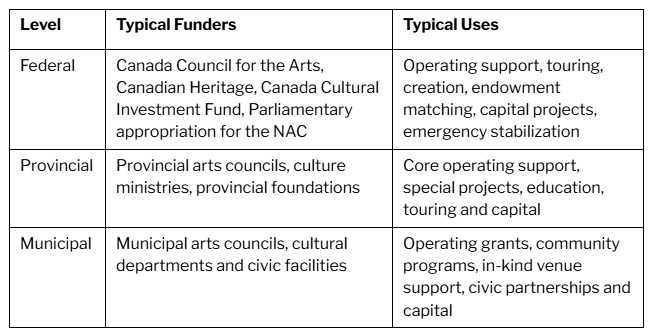
For not-for-profit musical groups and artists, which include symphonies, provincial and territorial grants have historically been the largest single category of public funding. In 2020, provincial and territorial support remained the largest category even though federal pandemic funding rose sharply.
Government funding performs several functions:
Operating stabilization: It supports the fixed costs of maintaining a professional orchestra.
Public-access subsidy: It helps make affordable concerts, school programs, and free outdoor events possible.
Risk sharing: It permits artistic projects that cannot be financed solely through ticket sales.
Capital support: It helps finance halls, renovations, accessibility improvements, and endowments.
Cultural policy implementation: Orchestras deliver public objectives involving Canadian artists, bilingualism, youth, regional development, diversity, and cultural participation.
During COVID-19, public support became unusually prominent. Orchestras Canada reported that government support rose from 30.5% of sector revenue in 2018–19 to 62.9% in 2020–21, before declining as earned and philanthropic revenues began to recover. Federal emergency support included the $500-million Emergency Support Fund for Cultural, Heritage and Sport Organizations and additional support through the Canada Council and Canadian Heritage programs.
The long-term challenge is that emergency public funding cannot permanently replace ticket income, donations, and sponsorships. Orchestras therefore need government advocacy that emphasizes both cultural value and financial leverage: public dollars stabilize organizations and encourage private donors, presenters, and corporate partners to invest.
1.3 Charitable Donations and Sponsorships
Philanthropy includes:
Annual individual giving.
Monthly giving.
Major gifts.
Gifts of securities.
Bequests and other planned gifts.
Endowment contributions.
Foundation grants.
Corporate gifts.
Corporate sponsorships.
Benefit events and galas.
Matching-gift campaigns.
Named funds, chairs, musicians’ positions and education programs.
In practice, orchestras often use a donor ladder:
Friends or annual donors.
Membership circles.
Patron or benefactor societies.
Major-gift portfolios.
Endowment and planned-giving programs.
Campaign leadership donors.
This structure allows an orchestra to cultivate a donor from a first ticket donation to annual giving, then to a major gift, capital commitment, or bequest.
The most significant distinction is between restricted and unrestricted philanthropy:
Unrestricted gifts support operating flexibility.
Restricted gifts support programs such as education, new commissions, tours, or community concerts.
Endowment gifts create long-term investment income but generally cannot be spent immediately.
Capital gifts support buildings, instruments, technology, and renovations.
A healthy orchestra needs all four categories. Over-reliance on restricted project gifts may produce impressive programming but insufficient support for musicians, administration, and core operations. Conversely, a strong annual fund without endowment-building can leave the institution vulnerable to economic cycles.
2. Six Major Canadian Orchestras
2.1 Orchestre Symphonique de Montréal
The OSM has one of Canada’s most sophisticated fundraising systems. Its philanthropic program is organized around:
Major gifts and planned giving.
Annual public giving through Friends of the OSM.
Honour Circle and Maestro Circle donor societies.
Corporate sponsorships.
Benefit events.
The OSM Foundation.
Touring and project sponsorship.
Education, accessibility, and community initiatives.
In 2022–23, the OSM reported nearly $4.4 million in donations. Major gifts and planned giving produced nearly $1.5 million, general-public donations approximately $513,000, and benefit events nearly $2.3 million. The events included the Bal des enfants and two OSM balls.
The OSM’s 2022–23 financial statements reported:
Ticketing and customer services: approximately $6.7 million.
Grants: approximately $14.9 million.
Performance fees: approximately $2.3 million.
Donations and sponsorships: approximately $9.8 million.
Touring: approximately $3.2 million.
Total revenue: approximately $37.7 million.
These figures show an orchestra with a substantial public-funding base but also a large philanthropic and earned-revenue operation. The OSM’s grants supported a season that included more than 100 paid-admission concerts and international touring, while its foundation contributed more than $3.2 million, including $2.4 million toward touring.
OSM Fundraising Practices
The OSM’s strengths include:
A clear donor architecture from entry-level giving to major philanthropy.
Fundraising linked to artistic excellence, education, and accessibility.
Benefit events that provide both revenue and relationship-building.
Sponsorship packages connected to the regular season, tours, and special events.
An endowment strategy administered through the OSM Foundation.
Monthly giving for long-term stability.
The OSM Foundation has pursued a major capitalization strategy. Its first phase sought to capitalize $60 million in perpetuity, a goal the foundation reports having achieved.
OSM donor appeals are notably multidimensional. They invite support for world-class performances but also for free outdoor concerts, affordable programming, young audiences, emerging musicians, and broader access to classical music.
2.2 Toronto Symphony Orchestra
The TSO has one of the deepest individual-donor cultures among Canadian orchestras. Its fundraising system includes:
Annual fund campaigns.
The Music Director’s Circle and other donor societies.
Major gifts.
Bequests and planned gifts.
Corporate partnerships.
Foundation grants.
Matching-gift campaigns.
Special project support.
Endowment giving through the Toronto Symphony Foundation.
For fiscal 2024, TSO government grants were approximately $5.34 million, consisting principally of:
Ontario Arts Council: approximately $1.86 million.
Canada Council for the Arts: $2.25 million.
Toronto Arts Council: $1.22 million.
Other government support: approximately $10,000.
The TSO’s charitable revenue can be considerable. In the fiscal year 2023–2024, the Toronto Symphony Foundation (TSF) received $3.2 million in donations. Driven by these donations and investment performance, the Foundation's total net assets grew from $69.39 million in 2024 to $77.17 million by June 30, 2025.
The TSO’s major philanthropic history includes the Beck family, whose cumulative giving has exceeded $50 million. In 2020, the estate of H. Thomas and Mary Beck made a gift reported at approximately $14.7 million, and the family’s cumulative giving surpassed $50 million.
In 2024, the Barrett Family Foundation announced a $15-million pledge, described by the TSO as the largest pledge in its history and the largest commitment to programming by a Canadian performing-arts organization.
Another instructive campaign was the TSO matching-gift campaign that raised $595,000 from more than 2,000 individuals. The campaign used lead gifts from Francine and Bob Barrett and an anonymous donor to create urgency and leverage smaller donations.
TSO Fundraising Practices
The TSO’s model demonstrates several important principles:
Long-term donor relationships can produce transformational cumulative giving.
Matching campaigns can broaden participation beyond major donors.
Donors can be invited to support programming rather than only buildings or endowments.
Major-gift appeals can connect institutional stability to the future of Toronto’s civic and cultural life.
Strategic planning should explicitly integrate earned and philanthropic revenue.
The TSO’s 2024–27 strategic plan emphasizes financial stability, deeper relationships with Toronto, younger audiences, multicultural communities, and the demonstration of community impact. It specifically identifies education, cultural enrichment, and community connection as arguments for philanthropy.
2.3 National Arts Centre Orchestra
NACO occupies a distinctive position because it is part of the National Arts Centre rather than an entirely independent orchestra. The NAC is a federal Crown corporation that owns and operates its building and reports to Parliament through the Minister of Canadian Heritage.
This structure creates a hybrid financing model:
Parliamentary appropriation.
Box-office and programming revenue.
Commercial operations.
Hall rentals and food and beverage services.
National Arts Centre Foundation support.
Corporate sponsorships.
Individual and foundation giving.
National campaigns.
In 2023–24, the NAC reported:
Earned revenue of approximately $42.9 million.
Programming ticket revenue of approximately $12 million.
A grant from the NAC Foundation of approximately $6.7 million.
More than $7.81 million raised by the NAC Foundation from more than 6,400 donors, corporate partners and foundations.
The broader NAC — not only NACO — raises funds for performance, creation, learning, and national artistic initiatives. This means that NACO benefits from a much larger institutional fundraising platform than a stand-alone orchestra.
NAC Fundraising Innovations
The most important NAC case is the National Creation Fund. The campaign sought $25 million to support new Canadian artistic creation. It reached $23 million after a 2016 $5-million leadership gift from Gail Asper, described as the largest single donation in the NAC’s history at the time.
The campaign was innovative because it did not simply ask donors to preserve an existing institution. It asked them to finance the creation of new Canadian work. That framing can be especially effective for donors who value innovation, national identity, artistic risk, and legacy.
The NAC has also used named-seat campaigns and designated funds. An earlier Theatre Renewal Campaign invited donors to “take a seat,” with gifts supporting facility renewal and artistic funds.
2.4 Vancouver Symphony Orchestra
The VSO combines:
Ticket and subscription sales.
Government funding.
Annual individual giving.
Corporate giving and sponsorship.
Special projects.
Foundation and endowment income.
Bequests.
Education and community-program support.
Facility-related and event revenues.
In fiscal 2023, Charity Intelligence reported approximately:
$6.0 million in donations and special-event revenue.
$5.3 million in government funding, or roughly 21% of total revenue.
Fundraising costs of approximately $1.39 million.
The VSO’s 2023–24 Report to the Community presents a broader revenue picture:
Earned revenue: 45%.
Contributed revenue: 26%.
Government: 19%.
Endowment: 9%.
Other: 1%.
Its public-sector support was divided approximately as follows:
Federal: 42%.
Provincial: 27%.
Municipal: 31%.
Its contributed revenue was divided approximately as follows:
Endowment fund: 33%.
Individual giving: 26%.
Special projects: 18%.
Bequests: 10%.
Corporate giving: 10%.
Foundations and grants: 3%.
This is a relatively sophisticated balance. The VSO’s endowment and bequest activity are particularly important because they provide long-term capitalization rather than only annual operating support.
VSO Fundraising Innovations
The VSO has used:
A dedicated Vancouver Symphony Foundation.
Endowment-building supported by federal matching opportunities.
Major-gift recognition.
Bequest cultivation.
Annual giving.
Special-project fundraising.
Corporate matching and sponsorship.
Community-focused programming.
The VSO’s Foundation generates investment income for the orchestra, while the Canada Cultural Investment Fund can match eligible private contributions to endowment funds.
A recent example of matching philanthropy is the 2024–25 campaign in which Gerald A.B. McGavin and TELUS collectively provided $200,000 in matching funds.
2.5 Calgary Philharmonic Orchestra
The Calgary Philharmonic’s revenue model includes:
Ticket sales and sold services.
Government grants.
Individual and corporate donations.
Foundation grants.
Benefit and sponsorship activities.
Investment income.
A substantial endowment foundation.
Facility and event relationships through Arts Commons (now the Werklund Centre).
In fiscal 2023, Charity Intelligence reported:
Ticket and sold-service revenue of approximately $3.8 million, or 29% of total revenue.
Government funding of approximately $4.0 million, or 31%.
Donations of approximately $2.5 million.
Investment income of approximately $2.4 million, or 19%.
The Calgary Philharmonic Orchestra Foundation administers donations and government grants for the benefit of the Calgary Philharmonic Society. Its 2024 financial statements reported:
Donations of approximately $476,600.
Canada Cultural Investment Fund endowment incentives of approximately $588,900.
A total Foundation contribution to the Society of approximately $2.6 million.
Endowment incentives received to date of approximately $13.4 million, requiring the Foundation to maintain approximately $26.8 million in endowed capital.
This illustrates the leverage available through matching endowment programs: private contributions can generate public matching support, while the resulting capital base provides investment income over time.
The orchestra’s donor recognition lists identify major supporters such as Joyce and Dick Matthews, Irene and Walt DeBoni, Ethelene and John Gareau, Ted and Lola Rozsa, the Taylor Family Foundation, the Honens Calgary Philharmonic Society Fund, Cenovus, CNOOC, the Calgary Foundation, and the Calgary Arts Development Authority.
CPO Fundraising Practices
The Calgary model is notable for:
A mature endowment structure.
Strong local family philanthropy.
Corporate and energy-sector partnerships.
Named funds and lifetime recognition.
Community-access programs that demonstrate public benefit.
Integration with a large, multi-tenant performing-arts facility.
The CPO’s Community Access activity, including tickets for newcomers, refugees, charities, military families, and first responders, provides concrete evidence for donor appeals focused on inclusion and civic participation.
2.6 Edmonton Symphony Orchestra
The ESO is closely integrated with the Francis Winspear Centre for Music. Its financial ecosystem includes:
Ticket sales and subscriptions.
Government grants.
Individual giving.
Corporate sponsorship.
Foundation grants.
Endowment and planned gifts.
Education programs.
Facility rentals and events.
Sponsorship of concerts and series.
Donations supporting both orchestra and facility operations.
The Winspear was built as the ESO’s performance home in 1997 and remains its principal venue.
The ESO and Winspear have used a shared donor proposition: support makes it possible for musicians to live and work in Alberta, sustains the orchestra, expands educational activity, and maintains a major downtown cultural facility.
The Winspear’s creation was itself a major philanthropy case. Francis Winspear contributed $6 million in 1988, described as Canada’s largest single private donation to a performing-arts facility at the time.
The organization’s recent expansion planning also illustrates a public-private model. The expansion project has received significant public support, including a reported $12.8-million commitment from the Government of Alberta.
In fiscal 2024, the Edmonton Symphony Society reported approximately:
$11.3 million in revenue.
Approximately 24% from donations.
Approximately 26% from government.
Approximately 6% from other charities.
Approximately $376,000 in fundraising expense.
The ESO’s donor reports show a broad base of individual, foundation, corporate, estate, and community-fund support. Long-term donors include the Bill and Mary Jo Robbins Fund, John and Barbara Poole, Harriet Snowball Winspear, the Edmonton Community Foundation, the La Bruyère Fund, and numerous family foundations.
3. Philanthropic Donors and Giving Patterns
3.1 The Largest Documented Donors
There is no single publicly available national ranking of all orchestra donors. Public recognition lists differ in whether they report annual gifts, lifetime giving, gifts to affiliated foundations, anonymous donations, or gifts to capital projects. Nevertheless, several major donors and families stand out.
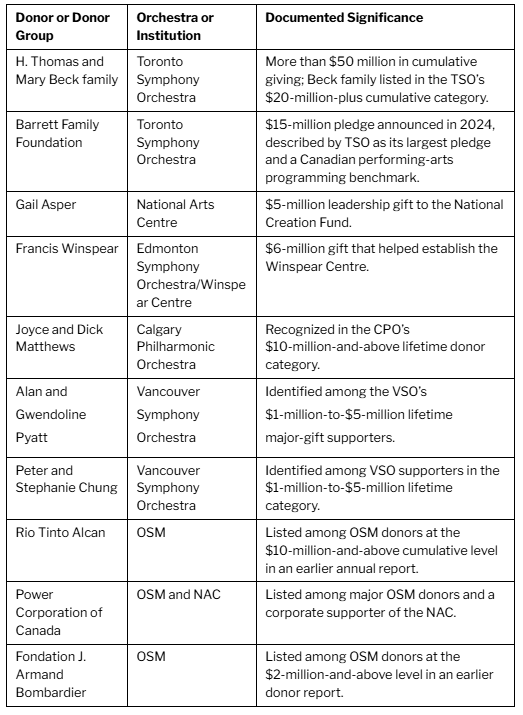
These examples demonstrate four recurring types of major orchestra philanthropy:
Family legacy giving: Beck, Matthews, Winspear, Pyatt, and other families.
Corporate cultural citizenship: Rio Tinto, Power Corporation, TELUS, BMO, CIBC and others.
Foundation-led strategic giving: Barrett Family Foundation, Azrieli Foundation, Bombardier Foundation, and local family foundations.
Capital and endowment philanthropy: gifts that create buildings, funds, instruments, or permanent income.
3.2 Why Donors Give
The most effective orchestra appeals usually combine several motivations:
Love of music and artistic excellence.
Personal connection to a conductor, soloist, musician, or program.
Desire to sustain a professional orchestra in the donor’s city.
Support for children, youth, and music education.
Belief in access and inclusion.
Pride in Canadian artistic achievement.
Interest in new music and innovation.
Desire to leave a family legacy.
Corporate hospitality and brand association.
Interest in civic revitalization and downtown vitality.
Desire to create a named space, fund, chair, or program.
Tax-effective giving through securities, estates, or foundations.
Donors generally want to understand not only what the orchestra does, but what their gift makes possible. A strong appeal therefore translates a general institutional need into a clear public outcome.
4. Case Studies of Successful Campaigns
4.1 OSM Foundation Capitalization
The OSM Foundation’s campaign to capitalize $60 million in perpetuity illustrates the importance of long-term financial architecture. Instead of asking donors only to fund the next season, the OSM invited them to secure the orchestra’s future, international recognition, and community role. The Foundation reports that the first phase achieved its $60-million objective.
Why It Worked
It offered a permanent legacy.
It separated immediate operating needs from long-term sustainability.
It gave major donors a strategic institutional role.
It connected capital to artistic, international, and community outcomes.
It created a platform for planned giving and endowment conversations.
4.2 TSO Matching-Gift Campaign
The TSO’s matching campaign raised $595,000 from more than 2,000 individuals. Lead gifts from Francine and Bob Barrett and an anonymous donor created a multiplier effect.
Why It Worked
It provided a simple reason to give immediately.
It made smaller donations feel consequential.
It used trusted lead donors to establish credibility.
It created urgency without requiring every donor to make a major gift.
It converted audience loyalty into broad-based philanthropy.
This is an especially useful model for orchestras seeking to rebuild post-pandemic donor participation.
4.3 NAC National Creation Fund
The NAC’s National Creation Fund sought $25 million to support new Canadian artistic works and reached $23 million after Gail Asper’s $5-million gift in 2016.
Why It Worked
It offered a national rather than merely local proposition.
It supported creation rather than institutional maintenance.
It appealed to donors interested in innovation, risk, and legacy.
It gave donors a visible role in the development of Canadian work.
It could support multiple disciplines and reach beyond a single orchestra.
For NACO, this type of campaign demonstrates how orchestral fundraising can be embedded within broader performing-arts and national-cultural priorities.
4.4 Winspear Centre Campaign
The creation of the Winspear Centre demonstrates how a major donor can become part of a city’s permanent cultural infrastructure. Francis Winspear’s $6-million gift helped establish the facility that became the ESO’s home.
Why It Worked
The gift supported a tangible civic asset.
Naming created enduring recognition.
The building served both the orchestra and the broader community.
The project attracted additional government and philanthropic support.
The case for support extended beyond concerts to education, events, and downtown development.
4.5 Calgary Philharmonic Endowment Model
The Calgary Philharmonic Foundation demonstrates the power of matching programs. Private gifts are combined with Canada Cultural Investment Fund incentives, with funds held in perpetuity and investment income used to benefit the orchestra.
Why It Worked
It converted annual philanthropy into permanent capital.
It offered donors a clear multiplier.
It reduced dependence on a single revenue stream.
It created a visible stewardship responsibility for the Foundation.
It gave the orchestra a durable asset in a volatile economic environment.
4.6 VSO Matching and Bequest Strategy
The VSO’s use of endowment, bequests, and matching funds shows how an orchestra can diversify major-gift activity beyond annual operations. In 2024–25, the VSO reported $200,000 in matching funds from Gerald A.B. McGavin and TELUS, while its lifetime donor recognition included substantial bequest and endowment support.
Why It Worked
It used matching funds to increase urgency.
It made planned giving visible and normalized.
It connected donors to long-term institutional resilience.
It diversified the donor pipeline beyond annual event attendees.
5. Best Practices for Fundraising
5.1 Build a Balanced Revenue Portfolio
Orchestras should establish explicit targets for:
Earned revenue.
Annual individual giving.
Major gifts.
Corporate sponsorship.
Foundation grants.
Government support.
Endowment income.
Planned gifts.
Event and rental revenue.
The objective is not to maximize one category. It is to reduce vulnerability by ensuring that no single source determines institutional survival.
5.2 Treat Donors as Long-Term Partners
Research on cultural philanthropy emphasizes that sustained relationship-building is more important than relying exclusively on gala revenue. The Montreal cultural-philanthropy study recommends evolving relationships with people close to the organization, integrating events into relationship development, involving artists and staff in philanthropy, and connecting ticketing and donor data through CRM systems.
Best practice includes:
Assigning relationship owners to major prospects.
Recording interests, attendance, giving, and engagement history.
Creating personal stewardship plans.
Reporting outcomes promptly.
Inviting donors into rehearsals, education programs, and artist conversations.
Using musicians, conductors, and board members as authentic ambassadors.
Offering meaningful, not merely transactional, recognition.
5.3 Integrate Ticketing and Fundraising Data
A patron who attends four concerts, donates modestly, brings guests, and participates in education events may be a stronger major-gift prospect than a one-time high-value ticket purchaser.
Orchestras should analyze:
Frequency of attendance.
Ticket value and purchase history.
Subscription tenure.
Ticket donations.
Event attendance.
Program preferences.
Geographic and demographic information.
Volunteer involvement.
Board and corporate relationships.
Giving capacity and philanthropic interests.
A unified CRM permits more precise segmentation and better donor journeys.
5.4 Use a Case-for-Support Portfolio
One generic annual appeal is insufficient. Orchestras should maintain separate cases for:
Artistic excellence.
Musicians and artistic personnel.
New Canadian music.
Music education.
Indigenous and community partnerships.
Accessibility and affordability.
Youth and emerging artists.
Endowment.
Touring and international representation.
Capital renewal.
Digital innovation.
Environmental sustainability.
Emergency operating support.
Different donors respond to different outcomes. A family foundation may prefer youth education, a technology company may prefer digital access, an energy company may prefer civic identity and economic impact, and an older individual may prefer an endowment or bequest.
5.5 Make Matching Funds Systematic
Matching challenges are effective because they:
Create urgency.
Reduce perceived risk.
Make each gift appear more valuable.
Encourage participation at lower giving levels.
Demonstrate leadership commitment.
Orchestras should use matching campaigns for:
Annual funds.
Education programs.
Endowment.
New commissions.
Community-access tickets.
Emergency musician support.
Digital and broadcast initiatives.
5.6 Strengthen Planned Giving
Planned giving is particularly well suited to orchestras because donors often have long emotional relationships with their local ensemble. Effective programs include:
Bequests.
Gifts of securities.
Charitable remainder arrangements where applicable.
Life-insurance gifts.
Registered-plan gifts.
Named endowments.
Legacy societies.
Planned-giving donors should receive individualized stewardship and should not be treated merely as deferred revenue prospects.
5.7 Demonstrate Measurable Public Impact
Orchestras should report more than attendance and concerts. Useful measures include:
Number of students reached.
Schools and communities served.
Free or subsidized tickets.
Newcomer and refugee participation.
Audience diversity.
Number of Canadian works commissioned.
Emerging artists supported.
Geographic reach.
Digital audience engagement.
Volunteer hours.
Economic activity generated.
Accessibility accommodations.
Repeat participation.
The strongest impact reports combine quantitative evidence with human stories.
5.8 Develop Corporate Partnerships Beyond Logo Placement
Corporate partners increasingly seek:
Employee engagement.
Client hospitality.
Community investment.
Youth and education outcomes.
Diversity and inclusion.
Downtown revitalization.
Environmental responsibility.
Innovation and technology.
Brand storytelling.
An orchestra should design sponsorships with multiple activation layers:
Concert sponsorship.
Employee rehearsals or workshops.
School programs.
Community ticket banks.
Digital content.
Artist talks.
Client events.
Named educational initiatives.
Matching campaigns.
5.9 Build Board Accountability
Boards should:
Make personally meaningful annual gifts.
Open doors to prospects.
Host cultivation events.
Participate in stewardship.
Understand the case for support.
Avoid treating fundraising as the sole responsibility of staff.
Use their networks ethically and inclusively.
Board participation should be measured by introductions, relationship activity, and stewardship — not only by the amount of the board member’s own gift.
5.10 Combine Accessibility with Excellence
The false choice between excellence and access is particularly damaging. Donors can be shown that high-caliber artistic work and public accessibility reinforce one another.
Effective appeals explain that philanthropy supports:
Affordable tickets.
Free concerts.
School performances.
Community workshops.
Music therapy and wellbeing partnerships.
New Canadian work.
International artistic achievement.
The professional livelihoods of musicians.
The OSM explicitly links donor support to excellence, education, accessibility, innovation, and community programs.
6. The Most Effective Donor Appeals
The following appeals are likely to be most effective when supported by a specific project, credible budget, and measurable outcome.
6.1 “Keep Exceptional Music in this City”
This is the core civic appeal. It positions the orchestra as essential cultural infrastructure rather than a discretionary entertainment provider.
Effective language should explain:
Why a professional orchestra matters locally.
What would be lost without it.
How the orchestra contributes to the city’s identity.
Why public and ticket revenue cannot cover full costs.
6.2 “Give a Child a Live Musical Experience”
Youth and education appeals are accessible to both major donors and the broader public.
A strong education case specifies:
Number of students reached.
Number of schools served.
Cost per student or classroom.
Teacher resources.
Artist involvement.
Long-term learning outcomes.
Access for underserved communities.
6.3 “Make Music Accessible”
This appeal is especially powerful when tied to free concerts, subsidized tickets, newcomer access, disability inclusion, and community partnerships.
The CPO’s documented community-access programs provide a useful example of translating inclusion into concrete ticket distribution and participation.
6.4 “Create the Canadian Music of Tomorrow”
New commissions and Canadian creation appeal to donors interested in legacy, innovation, and national identity.
The NAC National Creation Fund is a strong example because it framed philanthropy as venture capital for new Canadian artistic work.
6.5 “Secure the Orchestra Forever”
Endowment and planned-giving appeals should emphasize:
Permanent support.
Intergenerational impact.
Protection against economic volatility.
Named funds and legacy recognition.
The ability to support musicians and programs in perpetuity.
6.6 “Your Gift will be Matched”
This is the most direct short-term urgency appeal. It is particularly effective for:
Annual campaigns.
Digital appeals.
First-time donors.
Younger patrons.
Donors who need a reason to act now.
The TSO’s $595,000 matching campaign demonstrates how a lead gift can mobilize thousands of smaller donors.
6.7 “Support the Musicians”
Donors may respond strongly to appeals that connect funding directly to professional musicians, artistic livelihoods, and the continuity of the ensemble.
This appeal should avoid reducing musicians to a cost centre. It should frame musicians as:
Teachers.
Mentors.
Artists.
Community participants.
Ambassadors for Canadian culture.
The human foundation of the orchestra.
6.8 “Leave a Visible Legacy”
Named seats, funds, programs, rehearsal spaces, instruments, music stands, commissions, and educational initiatives can appeal to donors seeking recognition.
Naming opportunities should be governed by clear policies, fair valuation, and long-term stewardship. The NAC’s “take a seat” campaign illustrates how a relatively accessible named opportunity can make a capital campaign tangible.
7. Buildings: Ownership, Tenancy, and Shared Use
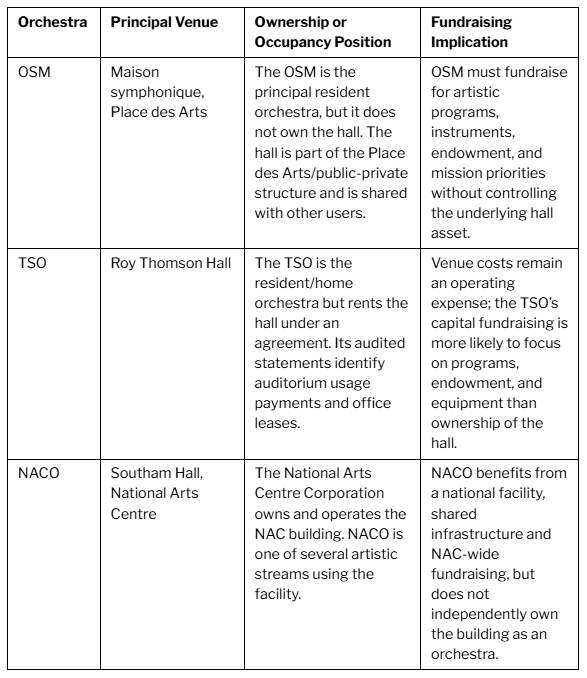
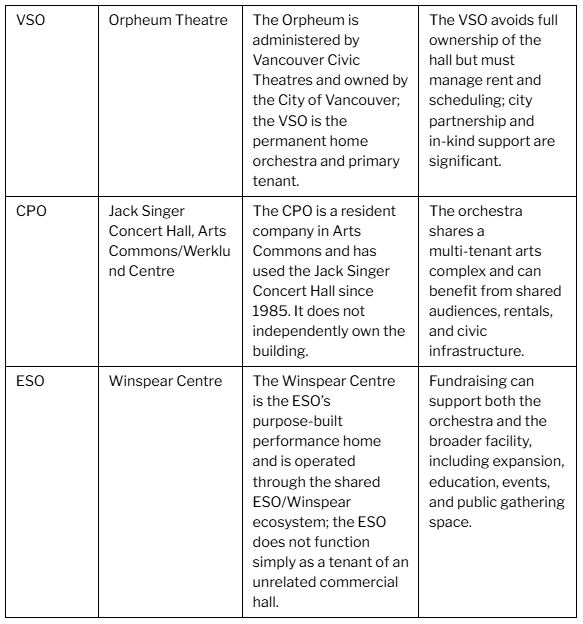
Building ownership is financially important because it affects rent, maintenance, capital obligations, event revenue, and the strength of a capital campaign. The six OC orchestras fall into three broad categories.
Important Qualification
“Owns its own building” can mean several things:
The orchestra legally owns the land and building.
A related foundation or affiliated corporation owns the building.
The orchestra operates a building owned by a separate nonprofit.
The orchestra is the anchor tenant in a civic or multi-tenant facility.
The orchestra is resident in a publicly owned or public-private venue.
Among the six organizations examined, the National Arts Centre Corporation is the clearest documented owner-operator, although NACO itself is an artistic component within that corporation. The ESO has the closest relationship to a purpose-built orchestra facility, but the operational and legal distinction between the Edmonton Symphony Society, the Winspear Centre, and affiliated foundation entities should be observed carefully. The OSM, TSO, VSO, and CPO principally use shared, civic, or independently operated halls rather than owning the primary concert venue outright.
8. Strategic Implications for Future Fundraising
8.1 The Sector Needs a Three-Part Funding Strategy
Future success will depend on aligning:
Public investment: stable core grants and capital support.
Earned revenue: audience development, flexible ticketing, touring, rentals, and digital activity.
Philanthropy: annual giving, major gifts, endowment, planned giving, sponsorship, and campaigns.
No one source is sufficient. Ticket sales cannot fully finance professional orchestras, philanthropy cannot reliably replace public policy, and government grants cannot provide all the flexibility required for artistic development.
8.2 The Strongest Future Cases will be Civic and Human
The most persuasive orchestra case is not “help us balance the budget.” It is:
Your support keeps exceptional musicians working, gives children access to live music, brings communities together, commissions Canadian artists, sustains a shared civic identity, and preserves an institution that future generations can inherit.
This message should be adapted by donor segment and supported by evidence.
8.3 Endowment and Planned Giving Should Grow
The examples of the OSM, VSO, and CPO demonstrate the importance of permanent capital. Endowment-building is particularly attractive when government matching programs are available. Orchestras should develop:
Dedicated endowment officers or shared expertise.
Planned-giving societies.
Securities-giving programs.
Family foundation partnerships.
Named funds.
Endowment impact reports.
Multi-year capitalization campaigns.
8.4 Campaigns Should Finance Creation and Access, not only Preservation
The NAC’s National Creation Fund demonstrates that donors can be inspired by ambition. Future campaigns should include bold, fundable propositions such as:
New Canadian commissions.
National touring.
Music education transformation.
Indigenous and community partnerships.
Accessible digital concert platforms.
New rehearsal and education spaces.
Climate-resilient facilities.
Youth musician academies.
Innovative concert formats.
8.5 Orchestras Should Make Smaller Donors More Important
The TSO matching campaign shows that a major campaign need not be limited to wealthy patrons. Orchestras can increase participation through:
Monthly gifts.
Low-dollar matching challenges.
Ticket-rounding.
Digital campaigns.
Young patron circles.
Peer-to-peer fundraising.
Community campaigns.
Donor-advised-fund outreach.
Workplace giving.
Broad participation strengthens legitimacy and creates future major-donor prospects.
8.6 Facilities Should be Treated as Fundraising Assets
Whether an orchestra owns, operates, or rents its hall, the venue is central to the case for support. Fundraising should address:
Accessibility.
Acoustic and technical renewal.
Energy efficiency.
Rehearsal capacity.
Education spaces.
Community use.
Digital production.
Naming opportunities.
Rental and event revenue.
Shared use with other arts organizations.
The Winspear model shows how a concert hall can be framed as a broad civic asset rather than a private home for one orchestra.
Conclusion
Canadian orchestras are funded through a balanced but fragile combination of tickets and service fees, government grants, charitable donations, sponsorships, benefit events, investment income, endowments, rentals, and performance fees. Across the sector, philanthropic revenue has become at least as important as government support, while earned revenue remains essential for public engagement and operating flexibility.
The six major orchestras examined here demonstrate distinct approaches:
The OSM integrates major gifts, events, sponsorships, touring, and a substantial foundation.
The TSO has developed one of Canada’s deepest individual-philanthropy cultures, including transformational Beck and Barrett family commitments.
NACO benefits from the financial scale and federal status of the National Arts Centre, including parliamentary support, earned revenue, and national foundation campaigns.
The VSO has created a strong endowment and bequest model supported by annual giving, government grants, and corporate matching.
The Calgary Philharmonic combines significant government and ticket revenue with investment income and a highly developed endowment foundation.
The ESO benefits from a purpose-built facility and a combined orchestra-and-venue fundraising proposition.
The largest philanthropic successes share several features: a credible lead donor, a clear and ambitious purpose, strong personal relationships, visible impact, meaningful recognition, professional stewardship, and a funding structure that combines immediate results with long-term sustainability.
The most effective future appeals will connect orchestral excellence with public value. Donors should be shown that their gifts support not only concerts, but musicians’ livelihoods, children’s education, Canadian creation, community access, newcomer participation, civic identity, and the preservation of cultural infrastructure. Matching gifts, endowment campaigns, planned giving, securities donations, and multi-year commitments should be integrated into a unified donor strategy.
For Canadian orchestras, the central fundraising opportunity is to move from a deficit-oriented narrative to an investment narrative. The question is not simply how donors can help an orchestra survive another season. It is how donors can help build a more accessible, innovative, financially resilient, and nationally significant orchestral culture for the next generation.
For Further Information
E-mail: info@vitreogroup.ca
Website: vitreogroup.ca
Telephone: 403-210-3157
About ViTreo
ViTreo is a full-service fundraising and non-profit leadership development firm. We have extensive expertise in every area of major gift fundraising and philanthropy. We offer a clear approach in an industry that can be overwhelming and often overcomplicated.
ViTreo Group has over a century of combined consulting experience with expertise in major campaign planning and management, talent acquisition, naming rights, non-profit governance, stakeholder engagement, and leadership development. We provide timely, creative and strategic advice to clients in the public and non-profit sectors. We are proud to have worked with hundreds of organizations from health, education, arts and culture, recreation, and social service to the environment.
ViTreo has a wealth of expertise and experience in every area of major gift fundraising and philanthropy. We provide just-in-time and retained strategic counsel to Canada's most influential board members, CEOs and opinion leaders.
Rooted in the word vitreous, "vitreo" is a Latin prefix meaning clear or resembling glass. Glass exemplifies many of our core values including transparency, clarity and utility.
Sharing Provisions
The information in this document has been developed by ViTreo Research. It is provided as information only. It may be shared under Creative Commons Attribution License. This license lets you distribute, remix, adapt, and build upon our work, even commercially, as long as you credit us for the original creation.