
How Catalytic Giving Can Impact Philanthropy
How Catalytic Giving Can Impact Philanthropy
Catalytic giving (commonly termed catalytic philanthropy) represents a paradigm shift from traditional charity to an approach designed to address the root causes of systemic social and environmental problems. Formally conceptualized in the philanthropic literature by Mark Kramer (co-founder of the social impact consultancy FSG) in his seminal 2009 Stanford Social Innovation Review piece, catalytic philanthropy views capital not as an end-state solution, but as a lever to mobilize external forces, alter market dynamics, and trigger large-scale systemic change.
Catalytic philanthropy is a strategy for accelerating systemic social change rather than simply funding worthwhile organizations or services. It uses money, time, relationships, convening power, and learning to shift the conditions that produce a problem, often by engaging multiple actors around a clear, measurable goal.
Catalytic giving is philanthropy that takes responsibility for progress on a social issue by mobilizing others, using tools beyond grantmaking, and building actionable knowledge for the field. In this model, the donor is not primarily a benefactor of individual organizations; the donor acts more like a change agent, co-strategist, and field-builder. The emphasis is on systems, incentives, coordination, and long-term change rather than one-off charitable transactions.
Core Practices
Catalytic giving typically includes a clear and focused purpose, equity-centered decision-making, deep community engagement, and multiyear flexible support for nonprofits. Other elements include taking responsibility for progress, engaging others in a campaign for change, and using tools beyond grantmaking such as advocacy, convening, and mission-related assets. Other models further highlight the importance of listening deeply, building strong relationships, understanding the landscape, and connecting grantees with each other and with other funders. In practice, these habits make philanthropy more adaptive, less paternalistic, and more able to respond to complexity.
The scholarly framework of catalytic philanthropy rests on four distinct, interconnected operational practices that require donors to move beyond the conventional role of passive grant maker to that of active change agent.
Practice 1: Taking Direct Responsibility for Achieving Results
In traditional philanthropy, donors effectively delegate the responsibility for solving social problems to the grantees. Catalytic philanthropists invert this model: they select a specific, bounded problem and take personal accountability for orchestrating its resolution.
Problem-First Mindset: Rather than evaluating which organizations to support, the funder determines what pieces of the solution are missing in the broader ecosystem.
Operational Agility: The funder maintains strict focus on the ultimate outcome, reserving the right to pivot strategies, create new entities, or discontinue initiatives if empirical data shows they are not moving the needle.
Practice 2: Mobilizing a Compelling Campaign
Because no single philanthropic entity possesses enough capital to solve a systemic crisis alone, the catalytic giver acts as a convener and campaigner. They design interventions explicitly structured to cross sectoral boundaries.
Multisector Alignment: They intentionally engage and coordinate non-profits, corporate entities, community organizers, and government agencies.
Collective Impact Orchestration: They often fund the "backbone infrastructure" needed to sustain long-term collaboration among otherwise fractured or competing organizations.
Practice 3: Deploying a Blended Toolkit (Beyond Grant Making)
Catalytic philanthropists recognize that traditional non-profit grants are only one tool among many. They view their capital as highly risk-tolerant and flexible, utilizing:
Catalytic Capital & Impact Investing: Employing debt, equity, or guarantees that accept below-market financial returns or higher risk to crowd-in commercial capital.
Political and Legal Levers: Actively funding advocacy, lobbying, litigation, and public policy reform to change the structural rules governing a system.
Corporate Asset Mobilization: Leveraging market-based forces, consumer demand, and corporate supply chains to create self-sustaining social impact.
Practice 4: Generating and Weaponizing Actionable Knowledge
Information is treated as a strategic asset. Rather than funding insular academic research, catalytic givers invest heavily in data gathering that is explicitly designed to change public perception or influence decision-makers.
Targeted Dissemination: Creating open-source, highly legible data, toolkits, and media campaigns targeted at specific audiences (e.g., legislators, corporate executives, or the general public) to drive immediate, measurable behavioral changes.
Traditional vs Catalytic
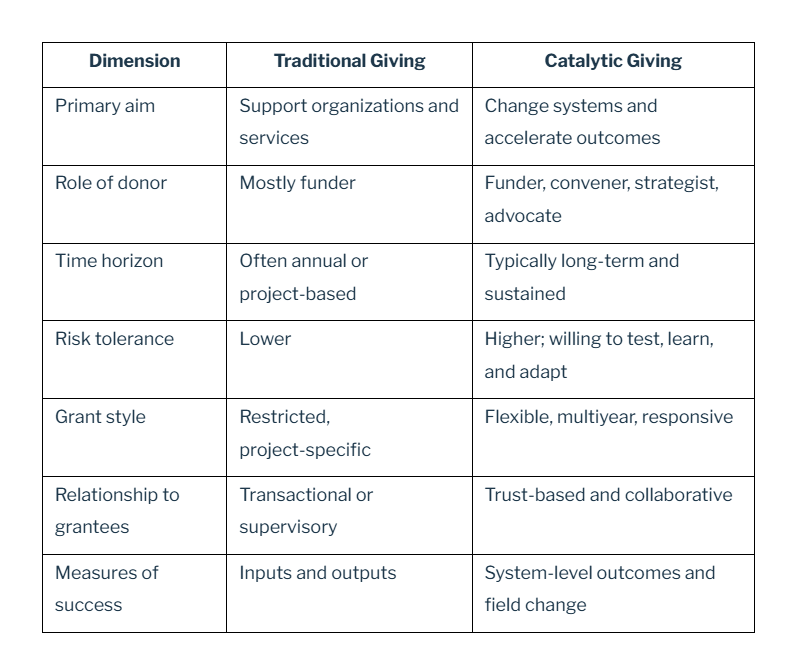
Traditional giving generally prioritizes supporting organizations and funding programs, with success often measured by dollars granted, activities delivered, or services expanded. Catalytic giving instead starts with the problem, not the institution, and asks what combination of capital, influence, advocacy, and partnerships can move the system. Traditional giving tends to be lower risk, narrower in scope, and more passive; catalytic giving tends to be higher risk, longer term, and much more active in shaping the field. Traditional donors may ask, “Which nonprofit should I fund?” while catalytic donors are more likely to ask, “What would it take to change the outcome itself?”.
Comparative View
The operational differences between traditional philanthropy and catalytic giving represent a shift across multiple dimensions, including risk allocation, power dynamics, and systemic scale:
Examples of catalytic approaches include:
Funding pilot programs to prove concepts before scaling
Providing capacity-building support (training, technology, infrastructure)
Offering challenge grants that require recipients to raise matching funds
Supporting policy advocacy that changes rules for entire populations
Seeding social enterprises that eventually become self-funded
Real-World Examples
Detroit’s post-bankruptcy recovery is one of the clearest examples in the literature. In the “Grand Bargain,” foundations pooled roughly $370 million to stabilize the city’s finances, preserve the Detroit Institute of Arts, and protect pensions. The same philanthropic leadership also helped launch Detroit Future City and the New Economy Initiative, both of which worked across sectors and beyond conventional grantmaking. The Stanford Social Innovation Review shows that philanthropy there acted as a civic anchor, using independence, networks, and credibility to fill gaps that neither government nor markets could address quickly enough.
Another well-known example is the Bill & Melinda Gates Foundation’s early malaria work, where a large grant helped elevate an underfunded issue and effectively catalyzed much larger global attention and investment. The same foundation’s education work is often described as catalytic because it sought structural change rather than only support to service delivery, using research, partnerships, and systems thinking to alter how education support was organized. More recently, catalytic funding has also been used to move high-risk innovations like Wolbachia-based mosquito control from proof of concept toward large-scale public-health adoption.
Case 1: The Meth Project
In the early 2000s, methamphetamine use in Montana was devastating communities, creating an unprecedented strain on public health and correctional systems. Traditional anti-drug funding was fragmented and largely failing.
The Catalytic Intervention: Tech entrepreneur Thomas Siebel launched the Meth Project. Rather than funding existing treatment facilities, Siebel took direct responsibility for a single metric: reducing first-time meth use. He realized the missing link was a raw, unfiltered public narrative to destroy the drug’s social appeal.
Tools & Knowledge: He funded a pervasive, hard-hitting media campaign built on rigorous, continuous consumer market research among teens. He paired this public awareness push with aggressive advocacy that successfully led to tougher state legislation on precursor chemicals.
The Systemic Result: Within years of implementation, Montana dropped from ranking #5 in the US for meth abuse to #39. First-time teen meth use declined by over 60%, and the model was scaled and adopted by multiple other states.
Case 2: AGRA and African Agricultural Development (The Rockefeller and Gates Foundations)
Historically, international development funding for African agriculture consisted of fragmented grants supplying short-term food aid or localized agricultural equipment.
The Catalytic Intervention: The Rockefeller Foundation and the Bill & Melinda Gates Foundation co-founded the Alliance for a Green Revolution in Africa (AGRA). They designed a multisector intervention aimed at changing the market architecture for smallholder farmers.
Blended Toolkit: Instead of handing out free seeds, they utilized catalytic capital to establish credit guarantees for local commercial banks, reducing the risk for banks to lend to small ag-retailers. They simultaneously funded training for local scientists to breed adaptive crops and successfully lobbied African governments to reform seed and fertilizer policies.
The Systemic Result: By addressing supply chain infrastructure, commercial finance barriers, and regulatory bottlenecks at the same time, the initiative unlocked billions in private sector commercial capital and transformed regional food security structures.
What the Cases Show
These cases show that catalytic philanthropy often succeeds when it does three things well: it funds early risk, it convenes diverse partners, and it stays engaged long enough to help ideas scale. They also show that catalytic giving is not limited to large foundations; even leanly staffed funders can work this way if they are disciplined about focus, relationships, and learning. The common thread is that the donor uses philanthropy to change the operating environment around a problem, not merely to alleviate symptoms. That is why catalytic giving is often tied to advocacy, systems change, and field-building rather than direct service alone.
Measuring Impact in Systemic Philanthropy
Measuring impact in systemic philanthropy is less about proving a direct cause-and-effect line from one grant to one outcome, and more about tracking whether the funder is helping shift the conditions, relationships, and incentives that shape a system. The best measurement approaches combine outcome data, contribution analysis, learning loops, and a clear theory of change.
What to Measure
Systemic philanthropy usually measures at three levels: the system, the funder’s contribution, and the pathway of change. That means looking at population trends, policy or practice changes, network growth, adoption of new models, and signs that the underlying system is moving in the intended direction. It also means tracking whether the funder’s role actually mattered, rather than assuming that every positive change should be credited to the philanthropy alone.
Useful Methods
A strong measurement approach usually starts with a baseline and a theory of change so the funder knows what success should look like and what comparisons are possible. Many funders use a mix of quantitative and qualitative methods, including dashboards, surveys, interviews, case studies, and participatory evaluation with affected communities. For more mature efforts, some organizations use social return on investment, contribution analysis, or multi-year evaluation designs, while accepting that attribution will often be partial in complex systems.
Common Challenges
The biggest challenge is attribution: in systemic work, many actors influence the same change, so it is usually unrealistic to claim full credit for outcomes. Another challenge is time horizon, because systems change often unfolds slowly and may show progress through intermediate indicators long before final outcomes appear. Data quality is also a recurring problem, especially when the work depends on partners with different reporting capacities or when the relevant indicators are not consistently available.
Practical Framework
A practical measurement framework for systemic philanthropy can be organized around four questions: What system are we trying to change? What outcomes matter? What contribution did we make? What evidence shows the pathway is working? That framework encourages funders to measure both results and learning, so they can adapt strategy rather than only report performance. It also keeps the focus on contribution and progress, which is more realistic than trying to force complex social change into a simple linear model.
Tools and Indicators
Common indicators include policy adoption, cross-sector collaboration, network density, capacity growth in grantee organizations, investment leveraged from other funders, and movement on population-level outcomes such as health, housing, education, or environmental indicators. In some cases, funders also track qualitative signals such as trust, leadership alignment, and the extent to which communities affected by the issue are shaping decisions. To be rigorous, pair “leading indicators” that show system movement with “lagging indicators” that show end results.
A Usable Donor Lens
For a philanthropist, the most useful question is often not “Did my grant work?” but “Did my capital, influence, and learning help move the system in the direction I intended?” That question shifts measurement away from vanity metrics and toward disciplined reflection on contribution, adaptation, and long-term change. In practice, that is the measurement mindset most aligned with catalytic and systemic philanthropy.
Practical Takeaways
Catalytic giving is considered an effective philanthropic strategy for several reasons:
Leverage and Multiplication
Rather than simply funding a need directly, catalytic giving unlocks additional resources. A single grant can attract matching funds, government investment, or other donors — multiplying the original dollar many times over.
Systemic Change Over Symptoms
Catalytic philanthropy targets root causes and builds capacity rather than just addressing immediate needs. The goal is to change systems, policies, or markets so that problems solve themselves over time, rather than creating ongoing dependency on donations.
Crowding In Other Capital
By de-risking an idea or proving a concept works, catalytic gifts encourage private sector investment or public funding that wouldn't otherwise flow to a cause. This is especially valuable in areas like clean energy, global health, or social enterprise.
Sustainability
Because the aim is to create self-sustaining change, catalytic giving ideally makes itself unnecessary. A successful catalytic grant might fund a nonprofit to the point where it becomes financially independent, or shift a policy so government takes over long-term funding.
High Impact Per Dollar
For donors with limited resources, catalytic giving can generate outsized impact. Funding research that proves a model works, or convening stakeholders to coordinate action, can achieve more than direct service delivery with the same money.
Summary
The core idea of catalytic giving is that the best philanthropic dollar isn't always the one that directly pays for a service — it's often the one that unlocks far greater resources, changes incentive structures, or builds lasting institutional capacity.
At its best, catalytic philanthropy is disciplined, relational, and systems-aware: it funds what is needed, learns from the field, and uses every asset a donor has to help create durable change. For a philanthropic actor trying to move from “supporting good work” to “changing the conditions that create the need for that work,” it is one of the most developed frameworks available.
For Further Information
E-mail: info@vitreogroup.ca
Website: vitreogroup.ca
Telephone: 403-210-3157
About ViTreo
ViTreo is a full-service fundraising and non-profit leadership development firm. We have extensive expertise in every area of major gift fundraising and philanthropy. We offer a clear approach in an industry that can be overwhelming and often overcomplicated.
ViTreo Group has over a century of combined consulting experience with expertise in major campaign planning and management, talent acquisition, naming rights, non-profit governance, stakeholder engagement, and leadership development. We provide timely, creative and strategic advice to clients in the public and non-profit sectors. We are proud to have worked with hundreds of organizations from health, education, arts and culture, recreation, and social service to the environment.
ViTreo has a wealth of expertise and experience in every area of major gift fundraising and philanthropy. We provide just-in-time and retained strategic counsel to Canada's most influential board members, CEOs and opinion leaders.
Rooted in the word vitreous, "vitreo" is a Latin prefix meaning clear or resembling glass. Glass exemplifies many of our core values including transparency, clarity and utility.
Sharing Provisions
The information in this document has been developed by ViTreo Research. It is provided as information only. It may be shared under Creative Commons Attribution License. This license lets you distribute, remix, adapt, and build upon our work, even commercially, as long as you credit us for the original creation.