
Social Enterprises of Indigenous Nonprofit Organizations in Canada
Social Enterprises of Indigenous Nonprofit Organizations in Canada
Executive Summary
Indigenous nonprofit organizations across Canada are pioneering an innovative approach to economic development through social enterprises — revenue-generating businesses designed to fulfill social, cultural, and environmental missions while generating self-sufficient income for their communities. These enterprises represent a strategic response to economic marginalization, limited government funding, and the imperative for self-determination. This report examines 15 documented case studies, synthesizes research from 589 screened documents (115 included in a comprehensive scoping review), and provides actionable analysis for Indigenous nonprofit leaders considering social enterprise development.
The evidence demonstrates that Indigenous social enterprises are most effective when characterized by 100% Indigenous ownership, governance, and control; alignment with cultural values of reciprocity and stewardship; clear community vision; and sustainable revenue models. However, they face systemic barriers rooted in colonial legislation, geographic remoteness, limited capital access, and organizational capacity constraints. This report provides detailed case studies, a typology of operational models, and a strategic SWOT framework tailored for Indigenous nonprofit decision-makers.
1. Defining Indigenous Social Enterprises in the Canadian Context
Indigenous social enterprises are organizations that blend economic activity with social, cultural, and environmental missions in ways distinctly rooted in Indigenous values and governance. Drawing from a 2022 scoping review spanning Australia, New Zealand, Canada, and the United States, Indigenous social enterprises are distinguished by several characteristics:[1] Links to resources in Footnotes at end of paper.
Defining Attributes:
Organizations led by economic, social, cultural, or environmental missions consistent with community benefit
Substantial income derived from trading (selling goods or services)
Reinvestment of majority of surplus/profit in mission fulfillment
Collective ownership and community-focused decision-making
Blending of traditional cultural values (reciprocity, stewardship, kinship) with Western business methods
Multiple bottom lines: economic, social, cultural, and environmental (the "quadruple bottom line")
Unlike conventional nonprofits dependent on donations and grants, or private businesses focused primarily on profit, Indigenous social enterprises operate on a hybrid model —pursuing community benefit through sustainable, earned-income business operations. Critically, research indicates that models with 100% Indigenous ownership, control, and management are more likely to improve health and wellbeing by strengthening self-determination, culture, and community resilience.[1]
2. Detailed Case Studies of Indigenous Social Enterprises in Canada
2.1 Community-Owned Development Corporations
Goodfish Lake Development Corporation (GFLDC) – Goodfish Lake, Alberta
Structure & Business Model: Band-owned holding company operating four subsidiary businesses serving the oil and gas industry in adjacent Fort McMurray.
Operating Companies:
Dry cleaning and laundry services
Sewing, garment manufacturing, and repair
Protective clothing rentals
Bakery services
Financial Scale: Revenue generated through service contracts with major clients (Syncrude Canada, Suncor Energy). Profits reinvested in community initiatives.
Employment & Impact: Created approximately 100 local jobs, representing 90% First Nations employment. Supported an employment agency providing training and job placement services. Environmental Management System (ISO 14001 certified) reflects community values regarding environmental stewardship.
Keys to Success:[2]
Visionary Leadership: Chief Sam Bull and the Economic Development Committee articulated a clear vision addressing local retention and economic development needs
Market Alignment: Identified growing oil and gas markets and matched them with community capacity
Client Partnerships: Strategic partnerships with Syncrude and Suncor for market forecasting and service tailoring
In-house Training: Cross-training programs built internal capacity and reduced dependency on external expertise
"South Hiring" Strategy: Recruited skilled personnel from outside the community while prioritizing local employment where possible
Challenges & Resolutions:[2]
Conflict of Interest (Nepotism): In small communities, family connections complicate hiring. GFLDC resolved this through competency-based selection processes and clear job descriptions with articulated competencies for each position.
Remoteness & Transportation: Addressed by providing transportation services to clients.
Community Debate: Business development generated tensions about impact on local culture and values. Resolved through employment policies (work-life balance), environmental management systems, and community reinvestment (funding local events).
Outcome: Transformed a poverty-stricken community into a regional economic hub, reducing social assistance dependency and improving socio-economic conditions.
Piruqsaijit Limited – Rankin Inlet, Nunavut
Structure & Business Model: Inuit-owned central management company coordinating six Inuit development corporations. Functions as a holding company managing approximately $75 million in diversified assets.
Core Activities:
Property management and maintenance services
Real estate development and leasing
Community infrastructure projects
Financing for other Inuit enterprises (cooperative mutual guarantee system)
Financial & Governance: 100% Inuit shareholders. Cooperative system of mutual financial guarantees enables member corporations to access capital despite Nunavut land lease restrictions (no private land ownership under Nunavut Land Claims Agreement).
Employment & Community Impact: Approximately 50% Inuit staff. Sponsors community wellness initiatives including youth sports teams, arts programs, and cultural events. Builds Inuit middle class and economic self-sufficiency.
Keys to Success:[2]
Collaborative Leadership: Shared governance model reflects Inuit values of consensus
Pooled Resources: Mutual guarantee system enables lending despite systemic barriers
"South Hiring" Strategy: Knowledge transfer from external hires builds local expertise over time
Diversified Portfolio: Multiple subsidiaries reduce risk and create economic resilience
Challenges: Nunavut-specific barriers (land ownership restrictions, geographic remoteness, small population base) overcome through cooperative structure and government support programs.
Atuqtuarvik Corporation – Rankin Inlet, Nunavut
Structure & Business Model: Investment and lending corporation managing approximately $70 million in capital, providing loans and equity financing to Inuit-owned small and medium-sized enterprises (SMEs).
Lending Activities:
Loan amounts: $100,000 to $3 million per business
Deployment: $68 million invested across 38 client businesses, representing 58 investments
Sectors: Mining, tourism, real estate, fishing, light manufacturing, retail
Financial Management: Partners with First Nations Bank of Canada and mainstream lenders for re-capitalization. Offers scholarships and bursaries via partnerships. Provides ongoing business training (~$60,000 per year average).
Keys to Success:[2]
Problem-Solving via Financing: Atuqtuarvik addressed critical capital gap — Inuit entrepreneurs categorized as "high risk" by conventional banking, despite viability
Strategic Planning: Board-driven 5-year business plans; structured risk assessment focusing on business viability
Governance Stability: Professional board management insulates lending decisions from political instability
Community Reinvestment: Distributions fund youth programs, sports sponsorships, cultural initiatives
Outcomes: Stimulates Nunavut economy; provides alternative to emigration; builds local wealth and capacity.
Caisse Populaire Kahnawake – Kahnawake, Quebec
Structure & Business Model: Community-owned credit union (savings and loan cooperative) serving the Mohawk community of Kahnawake. Total assets: $130 million. Adapted franchise model of Desjardins (Quebec cooperative banking network).
Core Services:
Savings and deposit accounts
Commercial and consumer loans
Mortgages and investment services
Community development fund
Unique Innovations: Developed "trustee agreement" allowing loans without land collateral (overcoming Indian Act restrictions prohibiting land as collateral on-reserve).[2]
Financial Returns & Community Impact:
Profits distributed as dividends (~$4 million since 2003)
Highest per-family income among First Nations communities
Community Development Fund finances local powwows, skate parks, educational initiatives
Accounts for seasonal work patterns (e.g., fishing seasonality)
Keys to Success:[2]
Borrowed Governance: Adapted Desjardins cooperative model while maintaining Indigenous control
Creative Problem-Solving: Trustee system enabled access to capital despite legal barriers
Cultural Sensitivity: Policies reflect community rhythms (seasonal employment patterns)
Transparent Leadership: Board members selected by community members; regular audits and reporting
Challenges Overcome: Indian Act land restrictions; language barriers (English-language training for staff); need for ongoing business education.
2.2 Off-Reserve Private Model
Donna Cona Inc. – Ottawa, Ontario
Structure & Business Model: Privately held information technology and management consulting firm. Offers IT services, strategic consulting, systems integration to both Aboriginal and non-Aboriginal clients.
Ownership & Control: Approximately 50% Aboriginal staff (Métis, First Nations, Inuit). Originated as spin-off from larger firms (Systems Interface, Sierra Systems).
Partnerships & Growth: Partners with IBM, CGI, and other IT firms for project delivery and knowledge sharing. Profits reflect community reinvestment philosophy: 18% of pre-tax profits shared with employees.
Community Impact:
Internships and apprenticeships build Indigenous talent pipeline
Support for national Indigenous initiatives (scholarships, donations to causes like Make Poverty History)
Demonstrates Indigenous capacity in high-value IT sector (challenges stereotypes)
Keys to Success:[2]
Founder Expertise: 10+ years IT industry experience enabled credible market entry
Off-Reserve Location: Urban Ottawa position provided access to larger market and tech talent pool
Public Relations: Actively combats stereotypes through marketing and community engagement
Employee Ownership Culture: Profit-sharing builds loyalty and aligns interests
Location Strategy Rationale: Off-reserve location deliberate — market for IT services much larger in urban centers. Demonstrates that Indigenous social enterprises can scale beyond reservation economy.
2.3 Cultural and Knowledge-Focused Models (International Parallels)
While Canadian-specific documentation is limited, the scoping review identified several high-embedded Indigenous social enterprises emphasizing cultural and environmental values:
Tjanpi Desert Weavers – NPY Women's Council, Australia
Model: Social enterprise enabling Indigenous women to earn sustainable income from contemporary fibre art using traditional materials and techniques.
Structure: Governed by NPY Women's Council; funded by Caritas Australia (Catholic international aid organization), but Indigenous board maintains decision-making authority (Supportive model).
Impact: Preserves weaving traditions; provides women's income; builds cultural continuity.
Lesson for Canada: Indigenous women in similar communities could develop fibre arts or craft-based social enterprises with philanthropic or grant support while maintaining cultural governance.[1]
Wandjina Tours – Australia (Evolved Model)
Evolution Model: Began as partnership between Indigenous director and non-Indigenous director. Transitioned over time to wholly Indigenous-owned and operated, moving from Delegative to Collective/Embedded model.
Lesson: Some Indigenous social enterprises begin with non-Indigenous partners due to capacity gaps or strategic reasons, but successful transitions to full Indigenous control improve cultural alignment and sustainability.[1]
2.4 Entrepreneurship Support Platforms
Pow Wow Pitch – National Platform
Structure: Grassroots community of Indigenous entrepreneurs across Canada ("Turtle Island"), founded by Sunshine Tenasco (Kitigan Zibi Anishinabeg). Registered nonprofit deriving revenue through sponsorships and donations.
Core Programs:
Annual pitch competition awarding micro-startup capital
Bootcamps and mentorship programs
Business training and live learning sessions
Free tools and resources for entrepreneurs
Alumni network and Seed Fund (emerging)
Growth Trajectory: Launched 7 years ago at Ottawa Summer Solstice Pow Wow. Expanded to national reach; pivoted to online delivery during COVID-19 pandemic. Received 1,000+ applications from all provinces and territories in a recent year.
Achievements: 20+ Indigenous entrepreneurs funded ranging from soap producers to photography studios. Partnerships with Invest Ottawa, National Association of Friendship Centres (NAFC), supporting urban Indigenous entrepreneurs.
Funding & Support: Received Investment Readiness Program (IRP) funding from Employment and Social Development Canada (2023). Seed-level sponsorships from Invest Ottawa. Plans for Indigenous Entrepreneur Awards and podcast series.
Philosophy: "Entrepreneurship is the path to self-sufficiency" and "a big part of Indigenous heritage" (reframing business as modern expression of traditional trade).[3]
Strengths as Model: Community-led (by Indigenous founder), culturally safe environment, addresses systemic barriers specific to Indigenous entrepreneurs, builds peer support network.[4][5]
Indigenous Clean Energy (ICE) Social Enterprise
Structure: Pan-Canadian not-for-profit platform advancing Indigenous inclusion in Canada's clean energy and renewable energy economy.
Activities: Leadership development, collaboration with energy companies, utilities, governments, development firms, cleantech innovators, academic sector, capital markets.
Mission: Position Indigenous peoples as leaders in clean energy transition while ensuring Indigenous ownership and benefit-sharing in energy projects.[6]
2.5 Community Service Nonprofits with Social Enterprise Components
Several Indigenous nonprofits operate with earned-income ventures alongside charitable services:
Central Urban Métis Federation (CUMFI) – Saskatoon: Community-based Métis nonprofit providing urban Aboriginal services; generates revenue from program fees and business partnerships.[7][8]
Indigenous Perspectives Society (IPS) – Canada: Charitable nonprofit offering Indigenous cultural education and leadership development; charges fees for training and consulting.[9]
Raven Indigenous Social Enterprises Society: Research and support hub promoting Indigenous social enterprise education and resources.[10]
3. Operational Models: A Framework for Understanding Indigenous Social Enterprises
Based on analysis of 115 documents, Hudson et al. (2022) developed a 7-Model Framework classifying Indigenous social enterprises by degree of Indigenous ownership, control, and management. This framework is critical for nonprofit leaders assessing their options:[1]
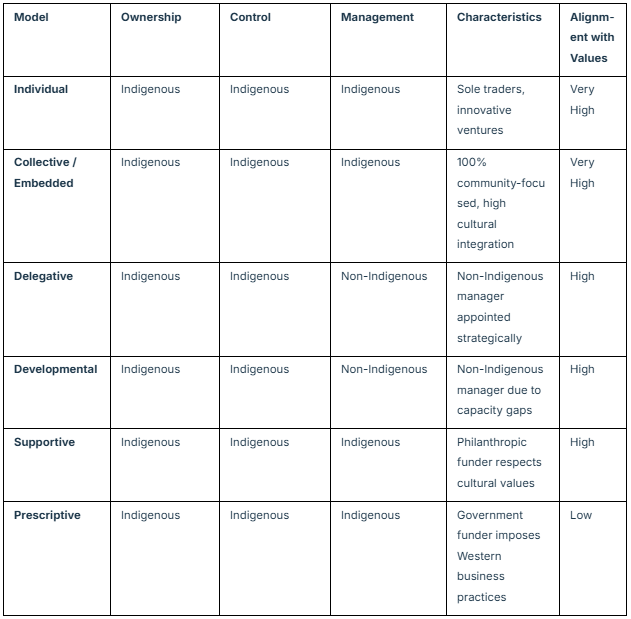
7- Model Framework classifying Indigenous social enterprises by degree of Indigenous ownership, control, and management.
Key Finding: Models with 100% Indigenous ownership and control (Models 1-2, 5) are significantly more likely to improve health, wellbeing, cultural strength, and self-determination than models with external control (Models 6-7).[1]
Selection Criteria for Nonprofit Leaders:
If your organization is considering a social enterprise:
Aim for Collective/Embedded Model (Model 2) if possible — highest cultural alignment and self-determination
Acceptable alternatives: Individual or Supportive models (if philanthropic partner respects governance)
Avoid Prescriptive or Paternalistic models if possible — external control undermines mission
4. Characteristics of Successful Indigenous Social Enterprise Business Models
4.1 Revenue-Generating Activities
Indigenous social enterprises in Canada span diverse sectors, reflecting community assets and market opportunities:[1]
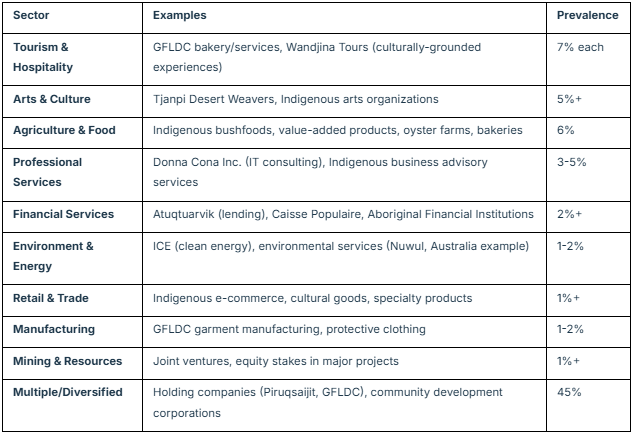
Indigenous social enterprises in Canada span diverse sectors, reflecting community assets and market opportunities.
Strategic Insight: Enterprises with multiple revenue streams (diversified portfolios) demonstrate greater resilience and sustainability. Single-activity businesses face higher risk if markets shift.
4.2 Blended Value Creation: Economic, Social, Cultural, Environmental
Indigenous social enterprises intentionally create "quadruple bottom line" value:[11]
Economic: Profit generation, job creation, wealth accumulation, financial independence
Social: Poverty alleviation, employment, skills training, reducing social problems (substance abuse, incarceration)
Cultural: Language preservation, traditional practice continuity, spiritual healing, knowledge transmission
Environmental: Land stewardship, sustainable resource use, climate action, ecosystem protection
Example from Case Studies:
GFLDC: Economic (100 jobs) + Social (reduced poverty, social event funding) + Environmental (ISO 14001 system) + Cultural (employment enabling family time, reducing out-migration)
Caisse Populaire: Economic (credit access) + Social (community fund) + Cultural (seasonal employment accommodation) + Environmental (lending to sustainable projects)
4.3 Hybrid Business Models: Combining Traditional and Western Practices
A defining feature of Indigenous social enterprises is the intentional blending of Indigenous governance and values with contemporary business methods:[1]
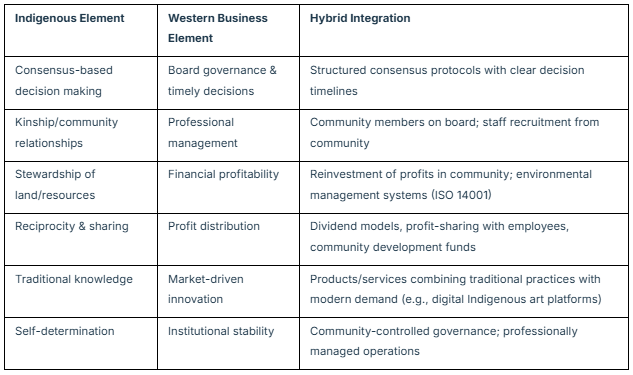
Critical Success Factor: Enterprises that authentically integrate Indigenous values rather than merely adopting Western business practices achieve stronger community support, lower staff turnover, and greater resilience.
5. Success Factors: Keys to Sustainable Indigenous Social Enterprises
Based on the Conference Board of Canada's analysis of five successful Aboriginal businesses and corroborated by broader literature, the following factors consistently emerge:[2]
5.1 Purpose-Driven Vision Rooted in Community Needs
Finding: Aboriginal businesses motivated by an important cause are more driven to succeed.
Examples:
GFLDC: Responded to critical need for local economic development and job retention
Atuqtuarvik: Addressed capital gap preventing Inuit business viability
Caisse Populaire: Resolved financial exclusion of on-reserve community members
Implementation Tactic: Conduct community asset mapping and needs assessment. Align business concept with community-identified priority (employment, cultural preservation, environmental protection, economic self-sufficiency).
5.2 Clear, Shared Corporate Vision
Finding: Successful enterprises articulate vision that (1) aligns market opportunities with community capacity, (2) is shared and supported by community, and (3) considers feasibility.
GFLDC Example: Vision was "establish series of companies that service oil and gas industry" — aligned with Fort McMurray market boom and existing community construction/trades capacity.
Implementation Tactic: Develop 5-year strategic plan including mission statement (cultural values), market analysis, competitive positioning, financial projections. Present to community for feedback and endorsement via band council or community meeting.
5.3 Winning Attitude: Leadership & Organizational Culture
Key Characteristics:[2]
Confidence and strong self-presence
Ability to facilitate knowledge transfer
Expert networking and advocacy skills
Calculated risk-taking
Commitment to continuous learning
Implementation Tactic: Invest in leadership development. Ensure CEO/executive director has both business acumen and deep community roots. Create workplace culture valuing mentorship and knowledge sharing.
5.4 Creativity in Problem-Solving & Overcoming Obstacles
Finding: The key to success is not planning for perfection but using creativity to address challenges.
Case Examples:[2]
Caisse Populaire: Developed "trustee agreement" alternative to land collateral
Atuqtuarvik: Partnered with First Nations Bank to create Nunavut's first bank
Piruqsaijit: Used mutual guarantee system to overcome land ownership restrictions
Implementation Tactic: Establish innovation working group. Empower teams to experiment with solutions adapted to local context. Document and share successful problem-solving approaches across network.
5.5 Strategic Location Selection
Finding: Location significantly determines viability based on (1) proximity to markets, (2) access to human/material resources, (3) distance from economic centers, (4) alignment with business model.
Examples:[2]
GFLDC: On-reserve location provided job retention benefit and cost advantages despite proximity to Fort McMurray market
Donna Cona: Off-reserve Ottawa location provided access to IT market and talent pool
Atuqtuarvik: Rankin Inlet provided access to Inuit population and government services
Implementation Tactic: Conduct market analysis for target sector. Evaluate trade-offs between on-reserve (cultural alignment, cost, retention) vs. off-reserve (market access, talent availability, growth potential).
5.6 Experience, Expertise & Capacity Building
Finding: Entrepreneurs with business education/training and industry experience are better equipped for success. Workplace learning culture improves productivity and quality.
Implementation Tactic: Require board members and senior staff to have relevant experience or willingness to undertake training. Establish mentorship and apprenticeship programs. Partner with post-secondary institutions (e.g., Indigenous business programs at Mount Royal University - Bissett School of Business).
5.7 Strategic "South Hiring" Combined with Community Prioritization
Finding: While community employment is priority, expertise often needs to be recruited from outside community, particularly in remote locations. This transfers knowledge and builds local capacity over time.
Implementation Tactic: Create explicit hiring policy: (1) prioritize community candidates with training pathway; (2) hire external expertise for roles lacking local skills; (3) require external hires to mentor community members; (4) establish timeline for transitioning to local management.
5.8 Recruitment & Retention Strategies
Finding: Indigenous businesses must compete with larger companies for talent.
Successful Strategies:[2]
Competitive salaries and benefits
Work-life balance policies (enabling cultural participation)
Advancement opportunities and skills training
Internship/apprenticeship programs
Profit-sharing arrangements (employee engagement)
Cultural alignment (meaningful work for community benefit)
5.9 Partnerships for Growth, Expertise & Funding
Finding: Strategic partnerships provide access to markets, expertise, capital, and co-ownership opportunities.
Successful Partnership Types:[2]
Financial partnerships: AFIs, banks (e.g., Atuqtuarvik with First Nations Bank), government programs
Business partnerships: Major clients (e.g., GFLDC with Syncrude), complementary businesses
Government partnerships: Infrastructure funding, procurement programs, economic development initiatives
Community partnerships: Other nonprofits, educational institutions, cultural organizations
6. Challenges Facing Indigenous Social Enterprises: A Typology
6.1 Systemic & Structural Barriers
Indian Act Restrictions on Land & Capital Access
Problem: Sections 89 and 20(1) of the Indian Act prohibit on-reserve land ownership and liens, severely limiting collateral available for business loans.
Impact: Banks charge 10%+ interest rates vs. 4% for off-reserve businesses; capital access severely constrained.
Solutions Documented:[2]
Trustee agreements (Caisse Populaire model)
Alternative security (equipment, accounts receivable)
Aboriginal Financial Institutions (AFIs) that assess character over security
Government loan guarantees and grants
Policy Implication: Federal government recognition that Indian Act barriers undermine economic development; increasing support for AFIs and alternative financing models.
Geographic Remoteness & Limited Markets
Problem: Remote Northern/rural communities face higher business costs (transportation, utilities), limited labor pools, smaller local markets.
Solutions:[2]
Diversified revenue streams (multiple markets, products, services)
Technology/e-commerce enabling market access
Government and philanthropic support for remote enterprise development
Partnership models enabling scale without relocation
Limited Access to Capital & Lending
Problem: AFIs (primary lending source for Indigenous businesses) have insufficient capital to meet demand. Current funding model is unsustainable.[12]
Scale: AFIs have provided $3.2B+ to 50,000 SMEs over 35+ years (NACCA); disbursing ~$100M annually. But demand is growing 5x faster than non-Indigenous entrepreneurship.[13]
Estimated Shortfall: AFIs need ~$78M in additional capital over next 5 years to meet projected demand.[12]
Solutions in Progress:
Aboriginal Developmental Lending Assistance (ADLA) program (2014-present)
Indigenous Growth Fund ($150M, with $75M deployed as of 2023)
Canada Infrastructure Bank loans for Indigenous equity stakes in major projects
Federal procurement program (increased to 6.1% of contracts in 2023-24, up from 5% target)[14]
6.2 Organizational & Governance Challenges
Conflict of Community Objectives
Problem: Business development generates debate over trade-offs between economic benefit and cultural/social values.
Solutions:[2]
Good governance (clear conflict-of-interest policies)
Employment equity programs (ensuring broad community benefit)
Environmental management systems (protecting land/resources)
Translation of products/services into local languages (cultural respect)
Transparent communication about trade-offs and reinvestment
Conflict of Interest (Nepotism)
Problem: In small communities where everyone is related, hiring based on merit is politically fraught. Political leaders may influence hiring.
Impact: Damages business credibility, reduces staff quality, creates internal resentment.
Solutions:[2]
Competency-based hiring with clear, documented job descriptions
Independent hiring committee (including non-community members if needed)
Written conflict-of-interest policies with enforcement
Separation of band council and business board
Political Instability
Problem: Band councils change election cycles; conflicts between band leadership and business board undermine trust of financial partners.
Solutions:[2]
Professional governance with business board independent of band council
Succession planning and contingency management
Risk management frameworks (business continuity despite political transitions)
Transparent financial reporting and auditing
Governance Complexity & Capacity Constraints
Problem: Indigenous governance often emphasizes consensus-based decision-making and multiple community voices, which improves legitimacy but slows decision-making. Smaller communities struggle to recruit skilled board members and staff.[15]
Solutions:[15]
Structured consensus protocols with clear decision timelines
Board recruitment from expanded geographic area (not only local)
Formal governance training and professional development
Support from governance institutes and consultants
Collaboration with other Indigenous organizations (shared capacity, peer learning)
Organizational Capacity Gaps
Problem: Few Indigenous nonprofit staff have formal business training or experience. Capacity gaps in financial management, marketing, HR, strategic planning.
Solutions:
Partnerships with Canadian Council for Indigenous Business (CCIB), Indigenous business advisory services, post-secondary business programs
Mentorship programs (peer and external)
Training through NACCA, AFIs, government programs
Investing in staff education (post-secondary programs)
6.3 Business-Specific Challenges
Lack of Business Planning
Finding: Only 21.9% of Aboriginal businesses implement formal business plans.[2]
Solutions:[2]
Partner with economic development officers or consultants
Use AFI business planning resources
Create simple 3-5 year plan including market analysis, financial projections, risk management, succession planning
Lack of Expertise in Key Functions
Problem: Remote communities lack professionals in key areas (accounting, HR, marketing, IT).
Solutions:[2]
"South hiring" with mentorship requirements
Partnerships with professional service providers
Outsourcing (e.g., accounting to firms, HR consulting)
Capacity-building partnerships
Poor Public Relations & Reputation Management
Problem: Lack of visibility leads to stereotyping and underestimation of Indigenous enterprise capabilities.
Solutions:[2]
Develop public relations strategy
Assign PR responsibilities to senior staff
Use media, social media, networking to highlight achievements
Participate in Indigenous business networks and showcases
Redistribution of Wealth Tensions
Problem: Businesses may generate wealth but community expectations about distribution (to employees, via taxes, via donations) create tension.
Solutions:[2]
Transparent profit distribution policies
Community investment fund governed by board (allocates portion of profits)
Clear employment policies ensuring local hiring
Regular community communication about business performance and reinvestment
6.4 External Systemic Barriers
Government Funding & Program Gaps
Findings from 2024 ISC Evaluation:[16]
Program funding insufficient to meet current and projected demand for loans and business supports
"Siloed" approach across sub-programs creates navigation challenges for entrepreneurs
Consistency in eligibility and approval across AFI network is lacking
Burdensome reporting requirements for AFIs and MCCs (Métis Community Councils)
Colonial Legacy & Systemic Discrimination
Finding: Indigenous entrepreneurs face discrimination in accessing mainstream financing, procurement, and partnerships. Deep structural inequalities embedded in federal/provincial legislation persist.[17]
Impact: More difficult to access capital, navigate bureaucratic processes, build partnerships with non-Indigenous businesses.
7. Impact on Communities: Documented Outcomes
7.1 Economic Impact
Employment:
GFLDC: 100 local jobs (90% First Nations)
Piruqsaijit: 50%+ Inuit staff; diversified employment across six corporations
Atuqtuarvik: 1,910+ jobs created/maintained through lending (as of 2015 ADLA program)
AFI Network: 3,700 businesses supported; ~1,000 new loans annually to Indigenous entrepreneurs
Wealth Generation:
GFLDC: Transformed community from poverty-dependent to economically self-sufficient
Atuqtuarvik: $68M deployed in Inuit businesses; stimulates economy in remote region
Caisse Populaire: Highest per-family income among First Nations (via cooperative model)
National: Indigenous economy contributed $50-56B annually to Canadian GDP[18][13]
Business Growth:
Pow Wow Pitch: 20+ entrepreneurs funded; 1,000+ applications annually
NACCA Growth Fund: 300+ Indigenous businesses supported with $75M deployed (2023-2025)
7.2 Social Impact
Education & Skills Development:
Case study enterprises prioritize mentorship, apprenticeships, internships
Knowledge transfer from "south hires" to community staff
Reduced out-migration (local employment reduces brain drain)
Poverty & Substance Abuse Reduction:
Employment opportunities address root causes (poverty, substance abuse, incarceration)
GFLDC example: Local employment reduced dependency on social assistance
Reduced need for crisis interventions
Family & Community Well-being:
Stable employment improves family stability
Profit reinvestment supports community events, sports, youth programs
Work-life balance policies enable cultural participation
7.3 Cultural Impact
Cultural Preservation:
Tjanpi Desert Weavers: Preserves traditional weaving practices and knowledge transmission
Indigenous Clean Energy: Integrates Indigenous knowledge in renewable energy solutions
Pow Wow Pitch: Reframes entrepreneurship as modern expression of traditional trade
Self-Determination:
Community-controlled enterprises affirm Indigenous sovereignty and decision-making authority
Models with 100% Indigenous ownership show strongest correlation with cultural strengthening[1]
Community Healing:
Employment and economic inclusion counter historical marginalization
Community-rooted enterprises embody reconciliation and nation-building
7.4 Environmental Impact
Sustainable Resource Management:
GFLDC: ISO 14001 Environmental Management System
Indigenous Clean Energy: Advances clean energy transition with Indigenous leadership
Caisse Populaire: Finances sustainable projects
Knowledge Integration:
Indigenous social enterprises blend traditional ecological knowledge with sustainable practices
Example: Indigenous clam gardens along Northwest Coast use traditional methods for marine biodiversity[19]
7.5 Evidence Gaps & Research Limitations
Critical Limitation: Only 37% of reviewed documents mention evaluation; no quantitative health outcome studies were found in the scoping review of 115 documents.[1]
Most evidence is qualitative or descriptive; rigorous impact evaluation is lacking. Nonprofit leaders should prioritize impact measurement (cultural, social, economic, environmental) to build evidence base and strengthen funding applications.
8. SWOT Analysis: Strategic Framework for Nonprofit Leaders Considering Social Enterprises
STRENGTHS (Internal Assets & Capabilities)
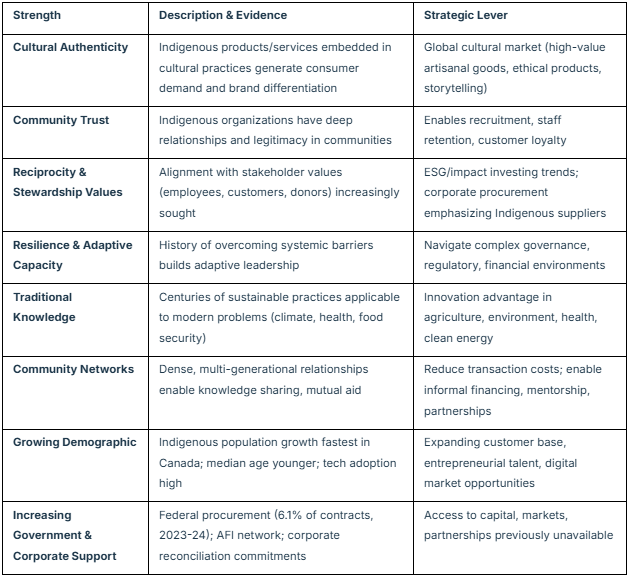
SWOT Analysis: Strengths
WEAKNESSES (Internal Constraints & Gaps)
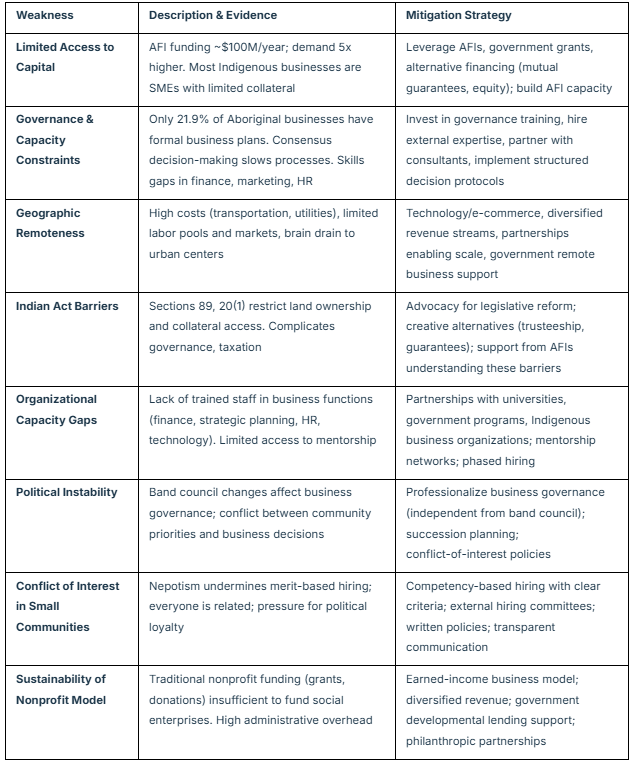
SWOT Analysis: Weaknesses
OPPORTUNITIES (External Conditions Enabling Growth)
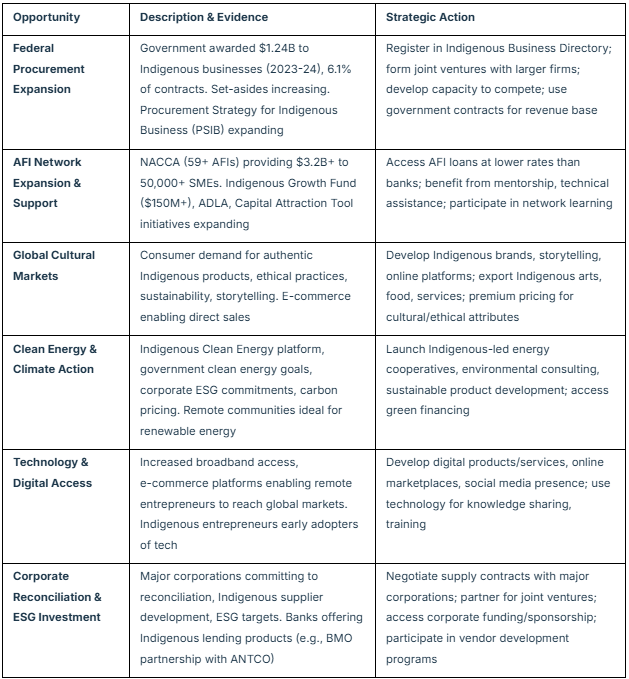
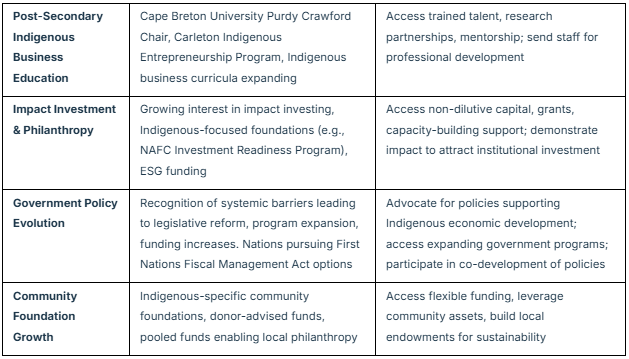
SWOT Analysis: Opportunities
THREATS (External Conditions Posing Risk)
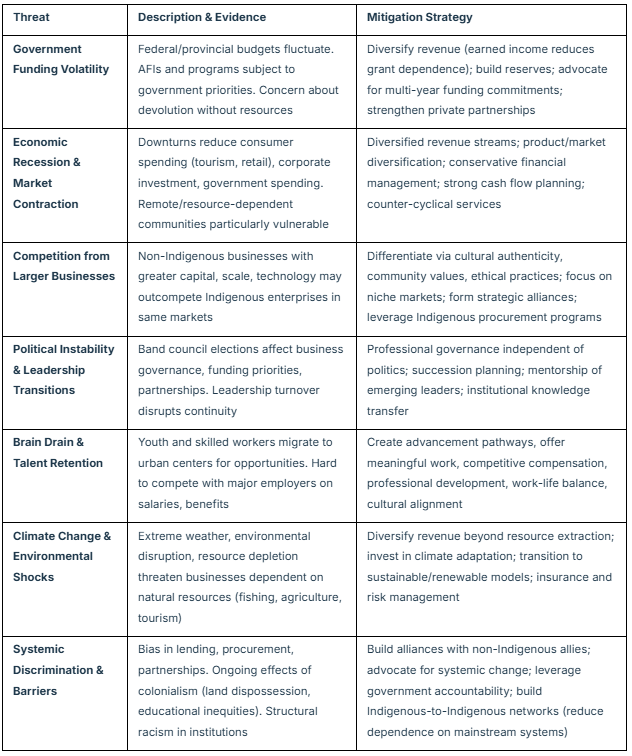
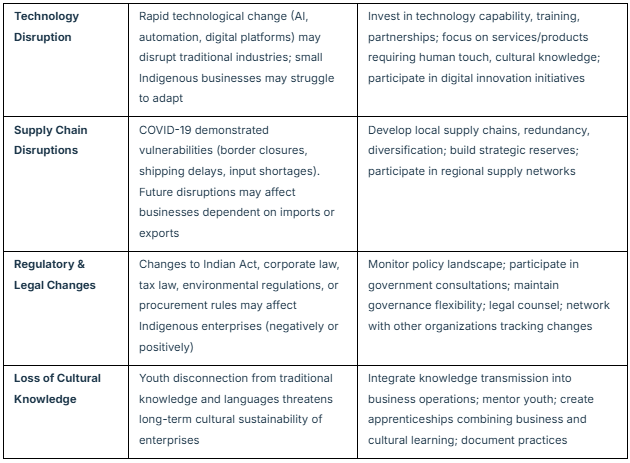
SWOT Analysis: Threats
9. Recommendations for Nonprofit Leaders: Launching a Social Enterprise
Based on the evidence from case studies, literature, and frameworks above, Indigenous nonprofit leaders considering social enterprise development should follow this roadmap:
Phase 1: Strategic Foundation (Months 1-3)
1. Conduct Community Assets & Needs Assessment
Identify community strengths (traditional knowledge, skills, networks, natural resources)
Identify market gaps or community needs
Survey community for support and vision alignment
2. Develop Clear Vision & Business Concept
Define purpose (what social/cultural/environmental mission will enterprise serve?)
Identify target market(s) and revenue model
Align concept with community values and strategic priorities
Set realistic financial and impact goals
3. Build Governance Structure
Establish board of directors (mix of community members, external expertise, young people)
Define roles, responsibilities, decision-making authority
Develop conflict-of-interest and personnel policies
Consider cultural governance models (consensus, hereditary leadership, elected)
4. Secure Initial Leadership & Expertise
Hire/appoint CEO or Executive Director with business + community knowledge
Identify mentors and advisors
Begin community recruitment for staff
Phase 2: Business Planning & Capitalization (Months 3-6)
5. Develop Formal Business Plan
Market analysis (customer research, competitive landscape, pricing)
Revenue projections (conservative, realistic, optimistic scenarios)
Cost structure and financial break-even analysis
Operations plan (location, staffing, technology, processes)
Marketing and customer acquisition strategy
Risk analysis and mitigation
3-5 year projections
6. Identify & Access Capital
Apply to AFIs (Aboriginal Financial Institutions) for loans and technical assistance
Research government grants (Indigenous Entrepreneurship Program, provincial/territorial programs)
Explore philanthropic funding (foundations, donors, impact investors)
Consider government loan guarantees or the Canada Infrastructure Bank (if applicable)
Evaluate equity partnerships or joint ventures
7. Build Partnerships
Identify potential clients or customers
Explore partnerships with financial institutions (AFIs, banks, credit unions)
Connect with other Indigenous businesses and organizations
Consider mentorship or partnership with larger businesses
Phase 3: Operational Launch (Months 6-12)
8. Establish Operations
Secure location and lease/purchase agreements
Set up accounting, HR, technology systems
Recruit and train staff
Develop standard operating procedures
Implement quality control and customer service systems
9. Marketing & Customer Acquisition
Launch brand (logo, website, social media)
Initiate marketing campaign
Build customer/community awareness
Establish customer feedback mechanisms
10. Monitor Performance & Adapt
Establish Key Performance Indicators (KPIs) for financial and social impact
Monthly/quarterly financial reviews
Customer and staff feedback
Adapt operations based on market response
Document lessons learned
Phase 4: Scaling & Sustainability (Year 2+)
11. Build Organizational Capacity
Invest in staff training and professional development
Strengthen governance through ongoing board development
Transition knowledge from founder to broader team
Document best practices and standard operating procedures
12. Diversity Revenue Streams
Expand product or service offerings
Explore new markets or customer segments
Consider complementary businesses (holding company model)
Reduce dependence on single revenue source
13. Reinvest in Community & Build Endurance
Establish community investment fund (allocate % of profits)
Support employee advancement and profit-sharing
Fund cultural, educational, environmental initiatives
Build reserves for sustainability through downturns
14. Measure Impact & Share Learning
Develop impact measurement framework (economic, social, cultural, environmental)
Conduct annual impact assessment
Share successes and lessons with other Indigenous organizations
Contribute to knowledge base on Indigenous social enterprise
10. Conclusion: Indigenous Social Enterprise as a Path to Self-Determination
Indigenous social enterprises represent far more than innovative business models — they embody a pathway toward economic self-determination, cultural resilience, and community healing rooted in Indigenous values of reciprocity, stewardship, and collective well-being.
The evidence from three decades of Indigenous business development in Canada demonstrates that enterprises with 100% Indigenous ownership, governance, and control — aligned with cultural values, serving community-identified needs, and generating sustainable earned income — can simultaneously achieve economic viability and profound social impact.
The case studies presented — from GFLDC's transformation of a poverty-stricken Albertan community into an economic hub, to Atuqtuarvik's mobilization of Inuit capital for Nunavut development, to Pow Wow Pitch's grassroots empowerment of emerging entrepreneurs —illustrate the breadth of possibility. They also reveal a consistent pattern: when Indigenous peoples control their economic futures, they thrive.
Yet systemic barriers remain — the legacy of the Indian Act, geographic remoteness, insufficient capital, governance complexity, and ongoing discrimination. Progress is evident: federal procurement has expanded; AFI networks continue to develop; government and corporate commitments to Indigenous economic development have increased. But demand far outpaces available support.
For nonprofit leaders contemplating social enterprise development, the evidence suggests a path forward that honors both Indigenous traditions and contemporary business realities. By grounding enterprises in community vision, intentionally blending Indigenous governance with professional management, diversifying revenue, and maintaining cultural authenticity, Indigenous nonprofit organizations can build sustainable engines of community prosperity.
The quadruple bottom line — economic, social, cultural, environmental — is not a compromise between profit and purpose. For Indigenous peoples, it is the authentic expression of enterprise itself: business as a means of strengthening the whole community across all dimensions of wellbeing.
The evidence is clear. Communities are ready. What remains is continued innovation, accumulated learning, and commitment to the vision articulated by Sunshine Tenasco of Pow Wow Pitch: "Entrepreneurship is the path to self-sufficiency. Entrepreneurship is a big part of Indigenous heritage. We are just reawakening to entrepreneurship."
References (links in Footnotes below)
Willow Lake Métis Group. (2025). How Métis-owned businesses strengthen communities. Retrieved from [20]
Fasken Martineau DuMoulin LLP. (2024). Canada's new Indigenous-run capital markets. Retrieved from [21]
Conference Board of Canada. (2008). From vision to venture: An account of five successful Aboriginal businesses. Retrieved from [2]
Pow Wow Pitch & National Association of Friendship Centres. (2024). Partnership announcement: Supporting Indigenous entrepreneurs. Retrieved from [3]
NACCA. (2025). Home page – NACCA National Aboriginal Capital Corporations Association. Retrieved from [22]
Nickerson, M. (2015). Developmental financing for Aboriginal businesses. Purdy Crawford Chair in Aboriginal Business Studies, Cape Breton University. Retrieved from [12]
SOI Foundation. (2021). Indigenous Clean Energy (ICE) Social Enterprise. Retrieved from [6]
Raven Indigenous Social Enterprise Society. (2023). About Raven. Retrieved from [10]
Indigenous Perspectives Society. (2025). About IPS. Retrieved from [9]
Hudson, S., Foley, D., & Cargo, M. (2022). Indigenous social enterprises and health and wellbeing: A scoping review and conceptual framework. International Journal of Environmental Research and Public Health, 19(21), 14478. Retrieved from [1]
Central Urban Métis Federation Incorporated. (2025). CUMFI profile. Retrieved from [7]
University of Victoria, Youth & Society Research Lab. (2020). Indigenous social enterprise & youth employment: Research brief. Retrieved from [11]
Willow Lake Métis Group. (2025). Community impact. Retrieved from [23]
Indigenous Services Canada. (2024). Evaluation of the Indigenous Entrepreneurship and Business Development Program. Retrieved from [16]
Turner, N., & Peacock, S. (2024). Navigating barriers and opportunities: Indigenous-owned SMEs driving sustainable international trade. American Institute for Business Research, 145139. Retrieved from [19]
Invest Ottawa & Pow Wow Pitch. (2023). Partnership supporting Indigenous entrepreneurs. Retrieved from [4]
Indigenous SME Initiative. (2025). Pow Wow Pitch: Supporting and empowering Indigenous entrepreneurs. Retrieved from [5]
Business Development Canada. (2025). Removing barriers to ensure Indigenous entrepreneurs soar. Retrieved from [18]
Parliament of Canada. (2021). Barriers to economic development in Indigenous communities. Standing Committee on Indigenous Affairs. Retrieved from [17]
Institute on Governance. (2023). Evolving Indigenous governance: Interview on organizational capacity. Retrieved from [15]
Banff Centre Lougheed Leadership. (2018). Restorying Indigenous leadership. Retrieved from [24]
Smith School of Business, Queen's University. (2026). Growing the Indigenous startup ecosystem. Retrieved from [13]
First Nations Financial Management Board. (2021). Standards for Indigenous not-for-profit organizations. Retrieved from [25]
Indigenous Services Canada. (2025). Facts about federal Indigenous procurement policies. Retrieved from [14]
The Philanthropist. (2025). When the expert is your cousin: Indigenous alternatives to conflict of interest. Retrieved from [26]
Future Skills Centre & CCIB. (2024). Skills for inclusive workplaces and advancement of Indigenous leadership. Retrieved from [27]
Sengupta, U., Viswanathan, M., & Gau, R. (2015). Indigenous communities and social enterprise in Canada. Anishinabek News & Social Enterprise Research Journal, 1(2), 15-45. Retrieved from [28]
Footnotes
https://indigenous-sme.ca/pow-wow-pitch-supporting-and-empowering-indigenous-entrepreneurs/
https://soifoundation.org/en/company/indigenous-clean-energy-ice-social-enterprise/
https://nacca.ca/wp-content/uploads/2017/08/PurdyCrawfordChair_CaseStudiesAboriginalBusiness.pdf
https://smith.queensu.ca/insight/content/Growing-Indigenous-Startup-Ecosystem.php
https://aprioboardportal.com/news/evolving-indigenous-governance/
https://www.ourcommons.ca/Content/Committee/441/INAN/Reports/RP11714230/inanrp02/inanrp02-e.pdf
https://truenorthaid.ca/canadian-charities-helping-indigenous-communities-in-canada/
https://fnfa.ca/en/capital-markets-firms-hitting-their-stride/
https://willowlakemetisgroup.ca/metis-owned-businesses-community-impact/
https://www.ccib.ca/wp-content/uploads/2024/11/Untapped-Potential-2.pdf
http://sbs-spe.feddevontario.canada.ca/en/indigenous-entrepreneur-guide-starting-business
https://fngovernance.org/wp-content/uploads/2020/10/First_Nation_Small_Business.pdf
https://www.metisnation.ca/what-we-do/economic-development-and-trade/
https://indigenousengagement.ca/indigenous-business-advisory-services/
https://sprott.carleton.ca/2022/empowering-indigenous-entrepreneurs-to-tackle-climate-change/
https://anserj.ca/index.php/cjnser/article/download/196/121/1118
https://www.rezbuddy.ca/articles/empowering-indigenous-entrepreneurs-first-nation-business-boom
https://scholarworks.waldenu.edu/cgi/viewcontent.cgi?article=18783&context=dissertations
https://www.edc.ca/en/article/building-relationships-with-indigenous-businesses.html
https://www.natureunited.ca/content/dam/tnc/nature/en/documents/ESSA-Final-Report.pdf
https://chamber.ca/resources/enhancing-business-indigenous-engagement/
https://imaginecanada.ca/en/press-release/new-study-equity-in-nonprofit-sector
https://energyconnectionscanada.com/the-leadership-circle-for-indigenous-inclusion/
https://www.conferenceboard.ca/wp-content/uploads/2022/10/indigenous-ownership_march2023.pdf
For Further Information
E-mail: info@vitreogroup.ca
Website: vitreogroup.ca
Telephone: 403-210-3157
About ViTreo
ViTreo is a full-service fundraising and non-profit leadership development firm. We have extensive expertise in every area of major gift fundraising and philanthropy. We offer a clear approach in an industry that can be overwhelming and often overcomplicated.
ViTreo Group has over a century of combined consulting experience with expertise in major campaign planning and management, talent acquisition, naming rights, non-profit governance, stakeholder engagement, and leadership development. We provide timely, creative and strategic advice to clients in the public and non-profit sectors. We are proud to have worked with hundreds of organizations from health, education, arts and culture, recreation, and social service to the environment.
ViTreo has a wealth of expertise and experience in every area of major gift fundraising and philanthropy. We provide just-in-time and retained strategic counsel to Canada's most influential board members, CEOs and opinion leaders.
Rooted in the word vitreous, "vitreo" is a Latin prefix meaning clear or resembling glass. Glass exemplifies many of our core values including transparency, clarity and utility.
Sharing Provisions
The information in this document has been developed by ViTreo Research. It is provided as information only. It may be shared under Creative Commons Attribution License. This license lets you distribute, remix, adapt, and build upon our work, even commercially, as long as you credit us for the original creation.